The cited memory your AI answers from

Everything you've read — ready before every client call.

ChatGPT invents sources and doesn't know your reading list. Pith remembers every article you save, summarises it, and hands you a cited briefing before the meeting — queryable straight from Claude or ChatGPT, too.

14-day free trial, no credit card. Starter €15 · Practice €35 per seat · Firm — contact us.

  • Data in Frankfurt
  • GDPR-compliant
  • No training on your content
Articles you save, distilled into concepts

Find Pith your way

Switching tools, or after an AI research assistant that cites?

However you got here, there's a door in: leave a tool that makes you author everything, or give your AI assistant a memory that answers only from what you've actually read — with citations.

Who's behind it

I build Pith as a tech consultant for my own work — and I'm customer number one. What you see here, I use every day myself."
S

Stefan

Founder of Pith

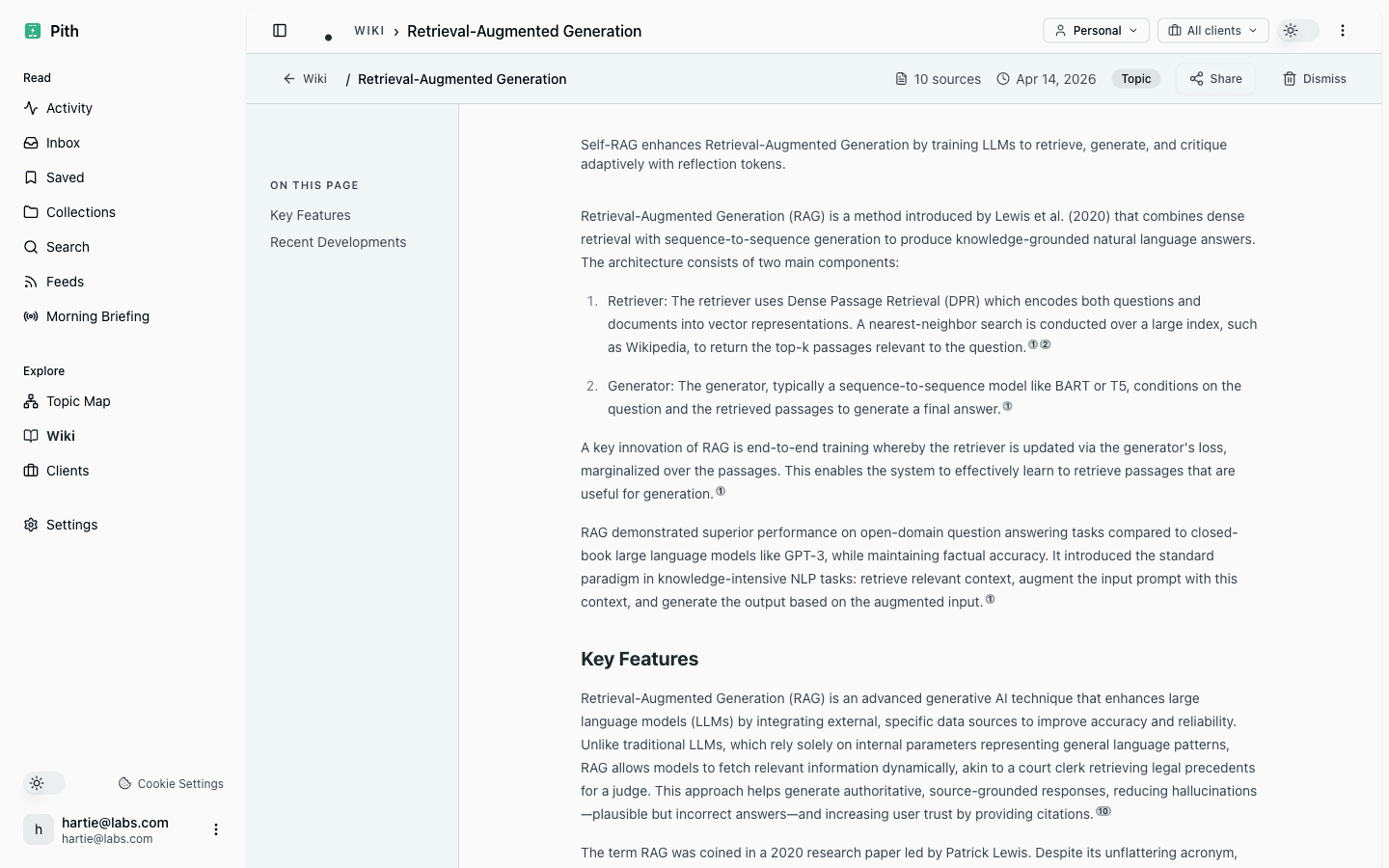
A Pith wiki concept page on Retrieval-Augmented Generation with cited sources
Real Pith UI — every claim is cited. No mockups.

What Pith is for

You read all day. The knowledge disappears anyway.

Pith turns what you read into knowledge you can actually retrieve — cited, searchable, and ready the moment a client asks. So reading pays off instead of evaporating.

01

When sources disagree, Pith tells you

Two articles, two claims: 'DORA deadline Q1' vs. 'pushed to Q3'. Pith catches the contradiction and shows you both sides — with sources. No chatbot does that.

02

A briefing before the meeting

A short rundown of what you read — listen or read.

03

A wiki that writes itself

Your reading becomes topic pages with clickable sources. You maintain nothing.

04

Your AI reads along

Ask Claude or ChatGPT what you already read. Answers come with the source.

05

Save in one click

Browser extension, phone, or RSS — articles in, summarised automatically.

How it works

From bookmark to briefing in four steps.

1

Save

Browser extension, mobile share-sheet, or RSS. The article is fetched, cleaned, and queued for processing.

2

Highlight

Mark passages as you read. Your highlights land in the wiki — searchable, citeable, and they resurface when they're relevant again.

3

Tag a client

Optional. Tag bookmarks with the engagement they belong to. Briefings, search, and the wiki then filter to that client's context.

4

Listen on Monday

Per-client briefing generated weekly. Audio-ready. Plays through the train ride to the client.

Real output

From your bookmarks to a wiki page.

Three real wiki pages Pith generated from articles you'd save during a normal consulting week. Every claim links back to a source. Click a badge to jump. Switch tabs to compare domains.

What you saved

Articles bookmarked across the week.

  1. 1

    DORA Article 30: Key Contractual Requirements

    securiti.ai

  2. 2

    DORA – Managing of ICT third-party risk

    fma.gv.at

  3. 3

    Digital Operational Resilience Act, Article 30

    digital-operational-resilience-act.com

  4. 4

    EU DORA Requirements for ICT Service Providers

    cm-alliance.com

  5. 5

    DORA Third-Party Risk: Register of Information & CTPPs 2026

    regulation-dora.eu

  6. 6

    DORA Article 30: ICT Contract Requirements for Financial Entities

    regulativ.ai

What Pith built

Auto-generated · 18 May 2026

Digital Operational Resilience Act Article 30

How EU financial entities must contract with ICT third-party providers under DORA.

The Digital Operational Resilience Act (DORA) Article 30 mandates specific contractual provisions that financial entities must embed in agreements with ICT third-party service providers to ensure operational resilience and risk management.1345

Key Features

Article 30 requires contracts for critical or important ICT functions to include over 15 mandatory clauses covering governance, risk mitigation, and operational resilience.245 Contracts must clearly define service descriptions, sub-contracting permissions, service locations, data-protection obligations, and incident-reporting duties.14

Risk Management and Compliance

The contracts must define each party's responsibilities, set service levels, and establish monitoring mechanisms for ICT risks.134 Financial entities retain audit rights — including direct access to provider premises — and termination rights with exit strategies that preserve business continuity.25

Why It Matters

Negotiating and enforcing these clauses is non-trivial with large ICT providers, but embedding them is the cornerstone of DORA compliance. The Register of Information cycle running through Q1 2026 makes contract gaps visible to supervisory authorities for the first time.56
Sources6 sources

  1. 1

    DORA Article 30: Key Contractual Requirements for Operational Resilience — Securiti

    https://securiti.ai/dora-article-30/
  2. 2

    DORA – Managing of ICT third-party risk — FMA Österreich

    https://www.fma.gv.at/en/cross-sectoral-topics/dora/dora-managing-of-ict-third-party-risk/
  3. 3

    Digital Operational Resilience Act (DORA), Article 30

    https://www.digital-operational-resilience-act.com/Article_30.html
  4. 4
  5. 5

    DORA Third-Party Risk: Register of Information & CTPPs 2026

    https://www.regulation-dora.eu/third-party-risk
  6. 6

    DORA Article 30: ICT Contract Requirements for Financial Entities — Regulativ.ai

    https://www.regulativ.ai/blog-articles/dora-article-30-a-strategic-guide-for-ict-providers-and-financial-entities
Explore the live demo →

Same pages are exposed via MCP — your AI assistant cites these sources too.

Features

See what your reading turns into.

Five things that set Pith apart from a notes app, a bookmark manager, or a chat-with-your-PDFs tool.

Auto-generated wiki page on Retrieval-Augmented Generation, with cited paragraphs and a related-pages sidebar.

Your reading writes itself into a wiki.

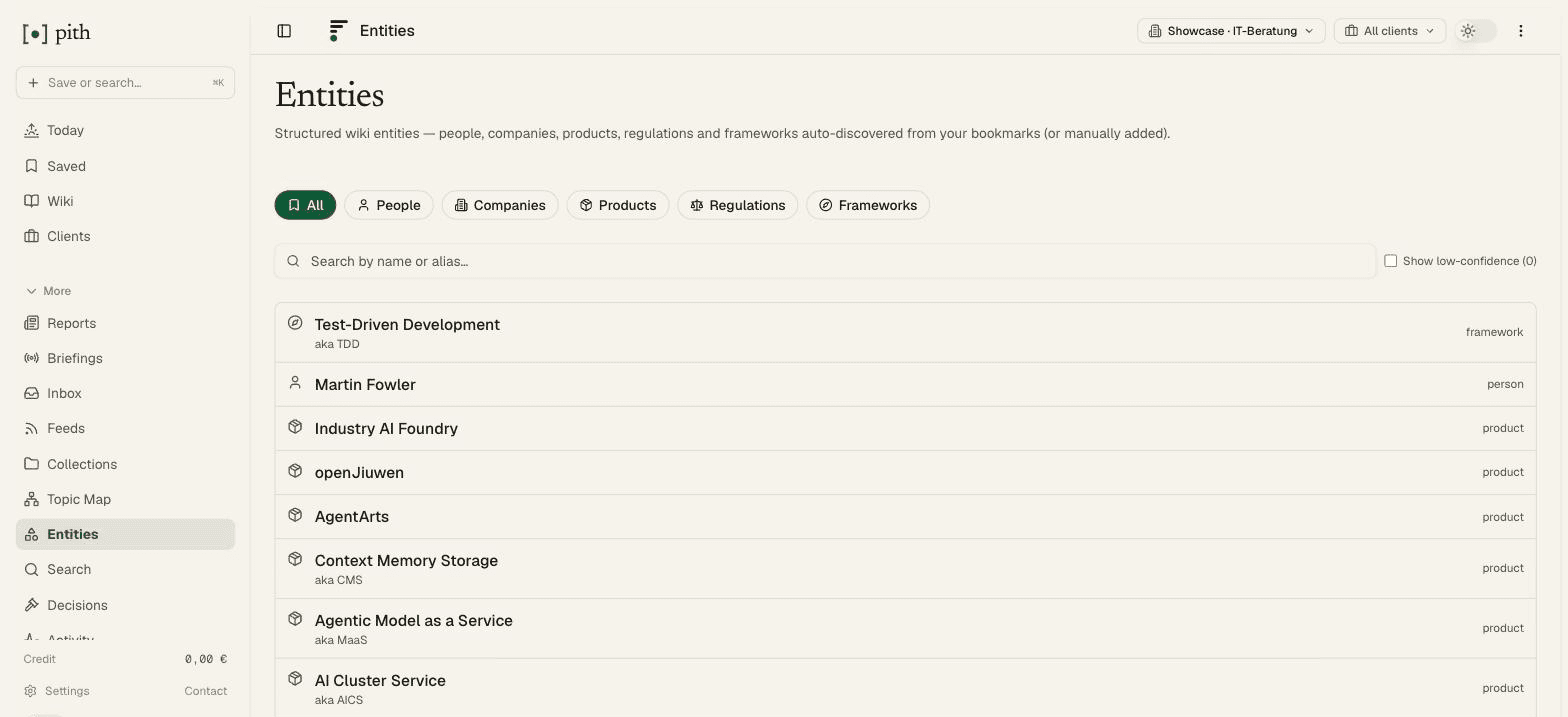
Concepts emerge from what you save — people, frameworks, regulations, technologies. Each page is built by an LLM from your bookmarks, with citations linking back to the source. No authoring required.

Learn more
Topic-map view with five color-coded clusters: AI & transformers, Rust, React, Database, DevOps.

See how your knowledge connects.

A force-directed graph of every bookmark you've saved, clustered by what they're actually about. Zoom out for the map; zoom in for individual cards. Surfaces connections you didn't notice.

Learn more
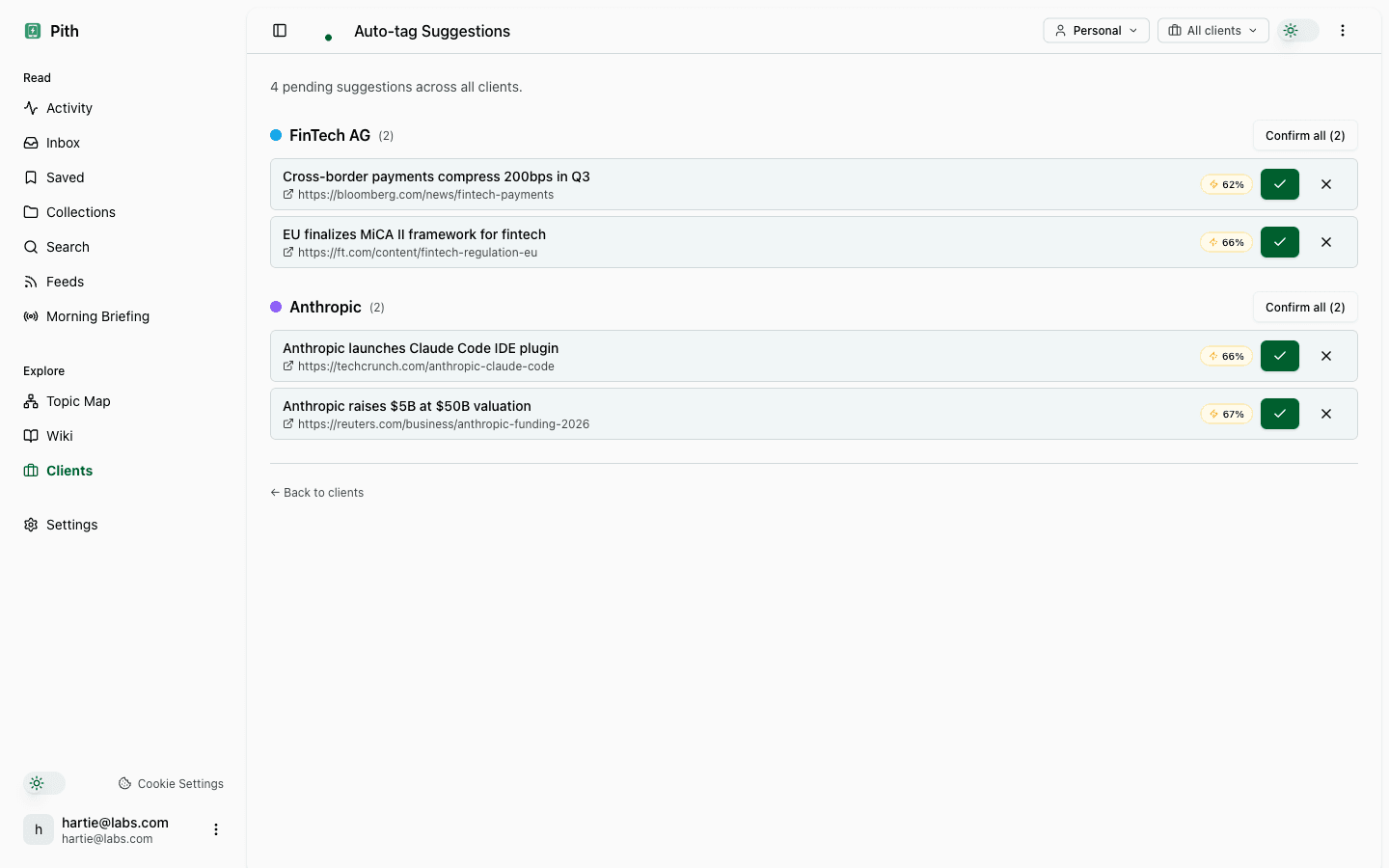
Auto-tag review queue with pending suggestions grouped under FinTech AG and Anthropic, each with a confidence percentage and confirm/dismiss buttons.

Bookmarks tag themselves against your accounts.

Pith scores every save against your client roster using entity matches, domain affinity, and embedding similarity. High confidence applies the tag automatically; mid confidence waits in a queue you clear in seconds.

Learn more
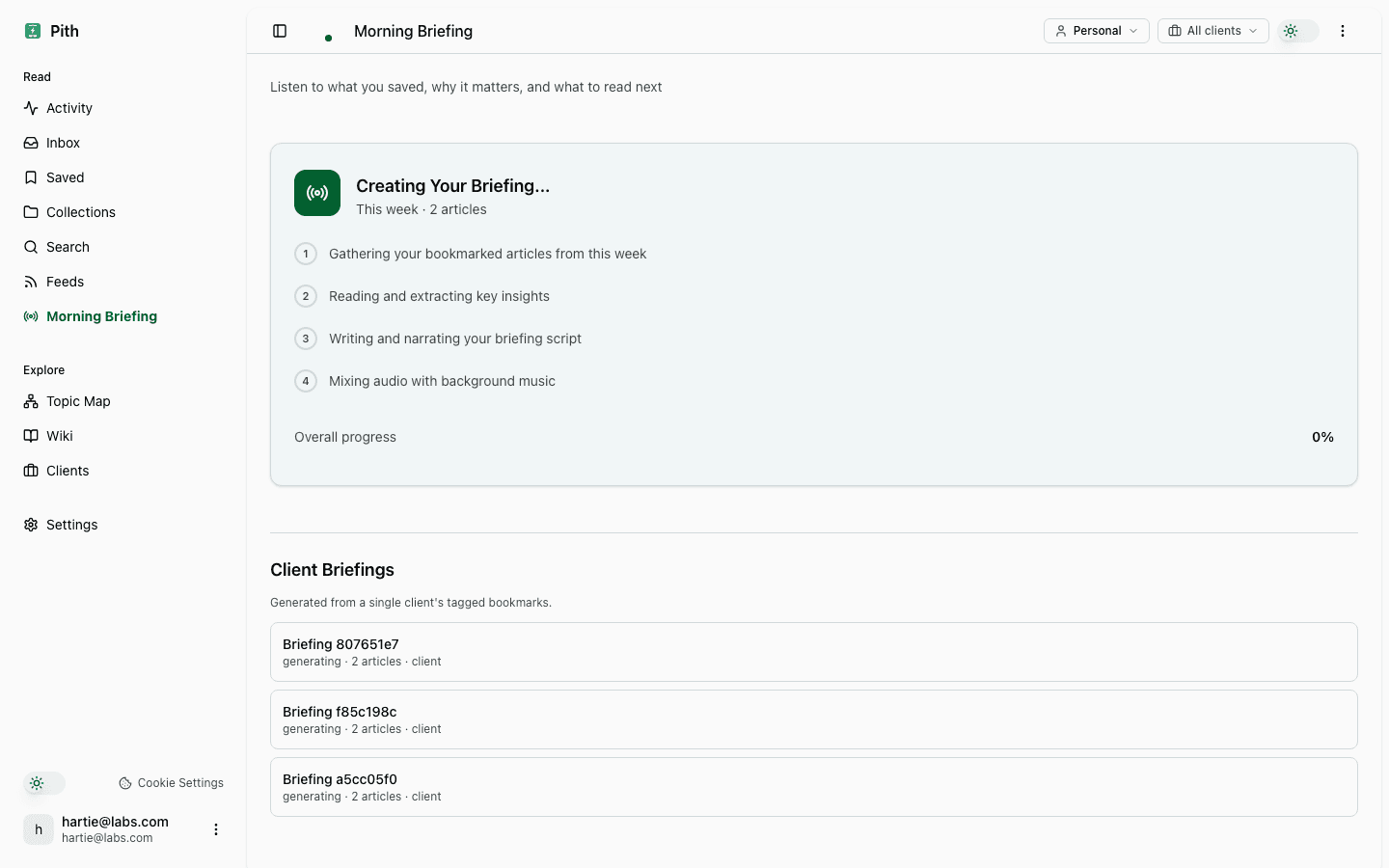
Morning Briefing surface with a 10-minute audio digest call-to-action.

An audio briefing before every meeting.

Generate a per-client briefing from this week's bookmarks and highlights. Text plus narrated audio. Listen on the train; arrive at the meeting prepared without scrolling through every link.

Learn more
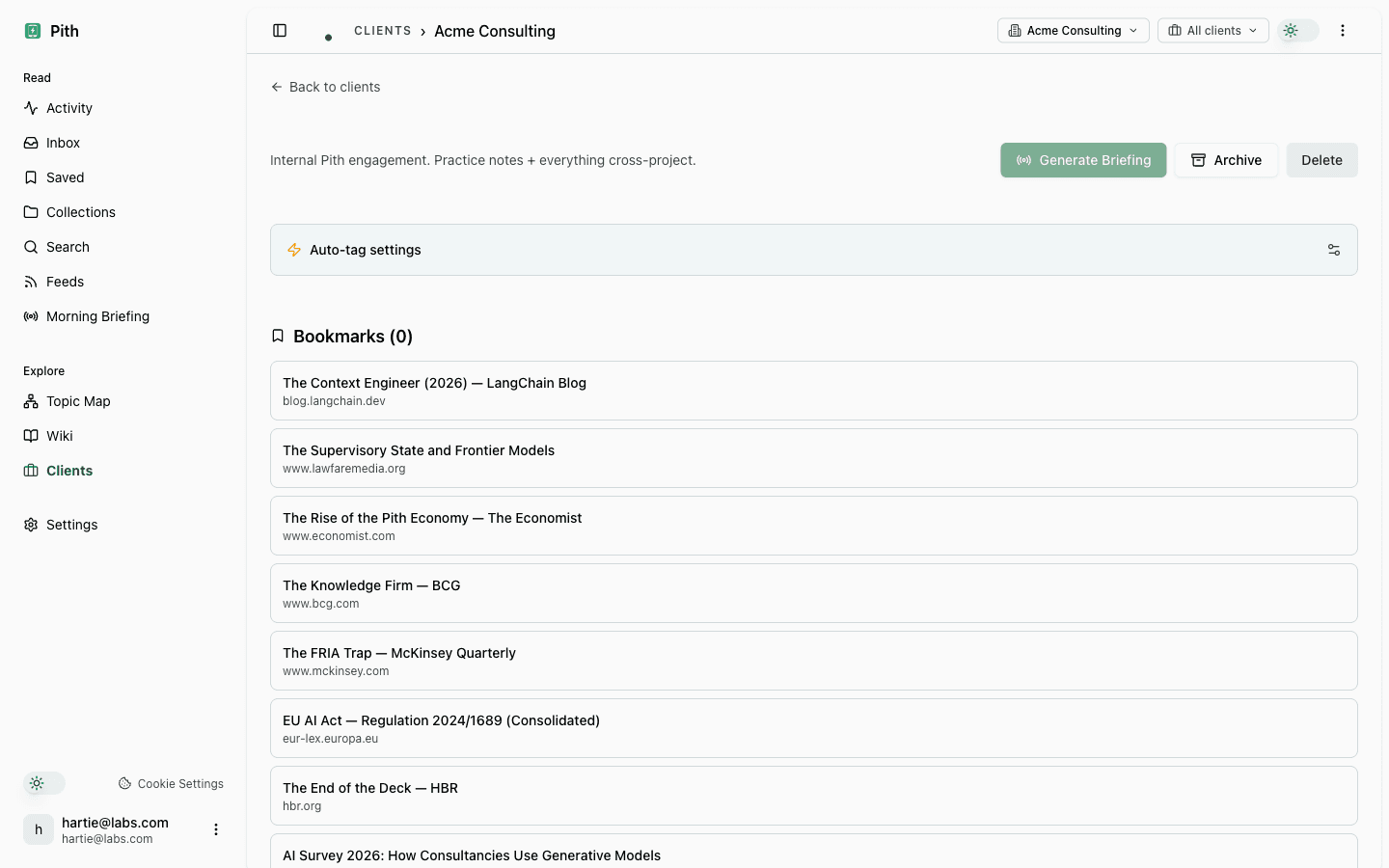
Acme Consulting client detail page with auto-tag settings panel and a list of recent client-tagged bookmarks.

A knowledge folder per client, kept fresh.

Tag bookmarks with clients to scope your wiki, search, and feeds to one engagement at a time. Each client gets an activity stream, briefings, and an auto-tagging settings panel.

Learn more

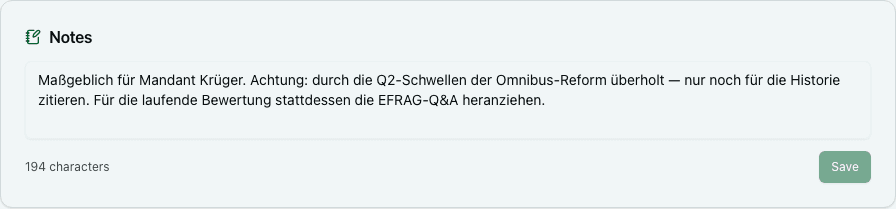
YOUR JUDGMENT

Your assessment, attached to the source.

Add your own notes to any source. Saved becomes savedassessed: your judgment beside the source, not just a pile of links.

why it matterswho it's forwhat supersedes it
FCA: Guidance on the Consumer Duty

From the Pith blog

Notes on knowledge work

Field notes from building a reading memory. Updated weekly.

FAQ

Common questions.

Who is Pith for?

Consultants, analysts, and small consulting firms. Anyone whose work depends on reading widely and re-finding what they read.

Why not just ChatGPT?

ChatGPT doesn't know your reading list, sometimes invents sources, and forgets everything after the chat. Pith remembers the exact sources you saved, cites them verifiably — and feeds that knowledge to ChatGPT or Claude when you need it. Not either/or: Pith feeds your AI what you actually read.

How is this different from Notion or Confluence?

Notion and Confluence are for writing things yourself. Pith writes itself: it remembers what you read, summarises it, and builds a wiki with sources — without you maintaining any pages.

Is my data isolated from other workspaces?

Yes — per-workspace database. Cross-workspace reads are impossible at the SQL layer, not just access-controlled.

Do you train models on my content?

No. Your content is used to generate your briefings, your wiki, your search results — and nothing else.

Can I export my data?

Yes, anytime. One-click export as a Markdown bundle + JSON. Your data is yours.

Does Pith work with Claude, Cursor or claude.ai?

Yes. Pith exposes your cited knowledge over MCP, so your AI assistant can query it directly — with source citations, no copy-paste into the prompt.

Try Pith free for 14 days.

No credit card. Cancel anytime. Your knowledge stays yours.

One re-found source a month pays for the seat. At a €200 hourly rate, Pith pays for itself in eleven minutes.