Buyers comparing AI research assistants — open-web answer engines vs. grounded, source-locked tools
"AI research assistant" covers two genuinely different jobs. One is open-web discovery: ask a question, get a synthesised, cited answer from whatever's published right now. The other is grounding: answer only from a specific, trusted set of sources, with citations you can defend. The best workflows use both — discover with one, remember and brief with the other. We lead with Pith because it owns the grounded, persistent end (answers only from what you've saved, cited, scoped per client), then cover the strongest tools for the adjacent jobs, honest about where each wins.
- 1
Pith
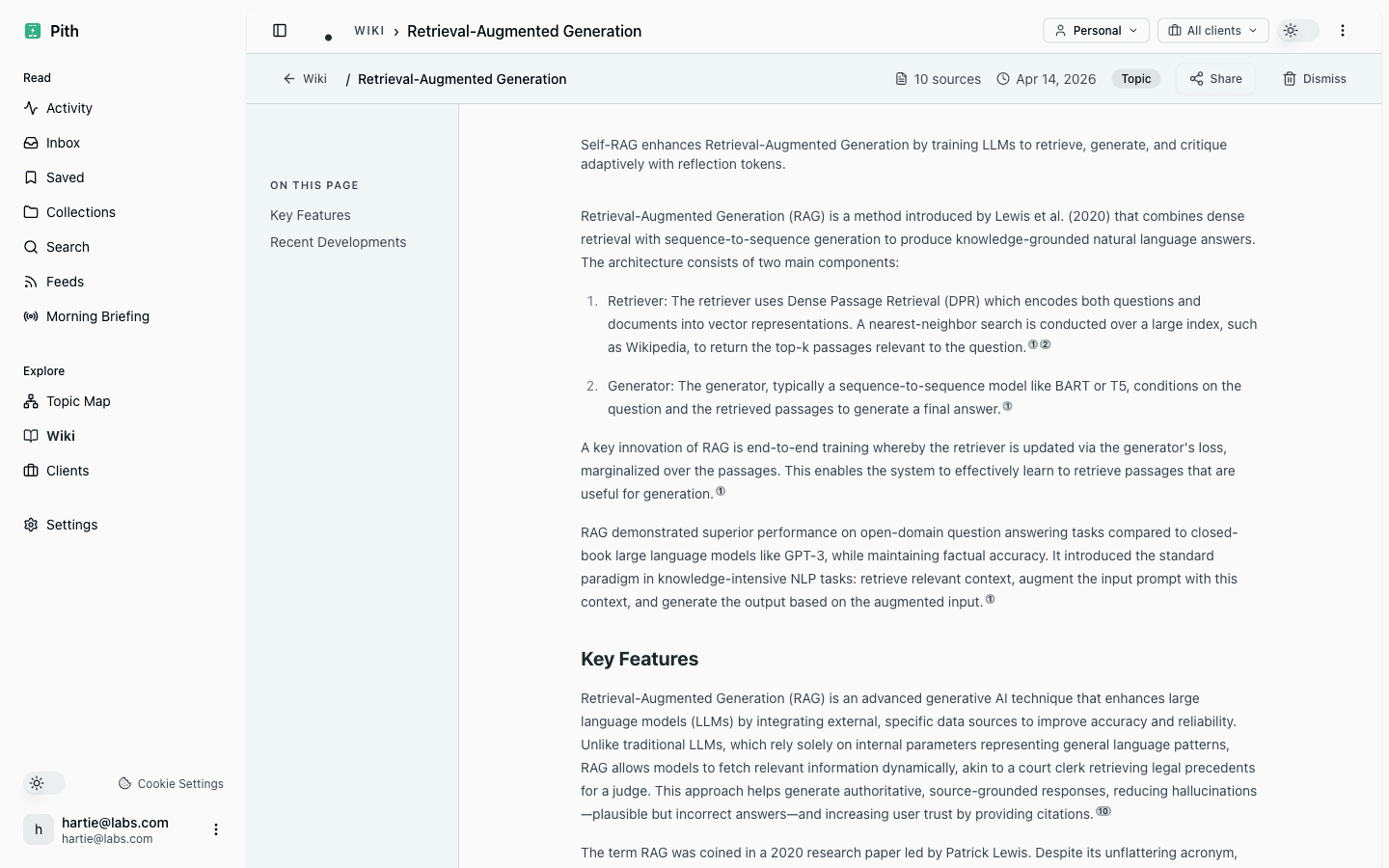
Visit sitePith is a persistent, cited reading memory: it auto-builds a wiki from the sources you bookmark, so your assistant answers from material you chose to trust — every claim linked back to its source — rather than the open web. It adds per-client scoping, audio briefings, and a hosted MCP server, with data in Frankfurt. It's the answer-from-your-own-reading end of the category, not an open-web search engine.
Good for: Grounding answers in your own vetted reading — defensible, cited, and scoped per client or project — and querying it from Claude or ChatGPT via MCP.
It only knows what you've saved: it won't discover new material on the open web or answer about a topic you haven't read, so pair it with a discovery tool.
- 2
Google NotebookLM
Visit siteA source-grounded assistant that answers only from documents you upload, with page-level citations, plus audio overviews and briefing docs. Excellent for interrogating a fixed corpus of reports, PDFs, or transcripts.
Good for: Asking grounded, cited questions across a defined set of documents you've gathered for a project.
Built around per-notebook uploads rather than continuous capture, and it's a Google-hosted consumer product — check data handling before adding client material.
- 3
Perplexity
Visit siteAn open-web answer engine that runs a live search and returns a synthesised answer with inline citations to current sources. Best-in-class for fresh questions and getting oriented in an unfamiliar topic.
Good for: Fast, cited answers to open-web questions and discovering new sources worth saving.
It's per-query and outward-facing — it doesn't keep a persistent, growing memory of the specific sources you've chosen to trust.
- 4
Elicit
Visit siteA research assistant for academic literature: it searches 125M+ papers and extracts findings into structured tables for systematic reviews, with strong screening and data-extraction tooling.
Good for: Systematic reviews and structured evidence extraction across peer-reviewed papers.
Tuned for empirical scientific literature, so it's a poor fit for business sources, the open web, or building a broad personal knowledge base.
- 5
Consensus
Visit siteAn AI search engine over 200M+ peer-reviewed papers that synthesises what the literature says about a focused question, with a "Consensus Meter" showing how much studies agree. Every answer traces back to cited papers.
Good for: Quickly gauging scientific consensus on a specific, empirical question.
It shines on yes/no empirical questions and is weaker for exploratory, theoretical, or non-academic topics.
- 6
ChatGPT (Deep Research)
Visit siteA general assistant that can browse, analyse uploaded files, and run multi-step "deep research" that compiles a sourced report. Versatile for drafting, analysis, and ad-hoc investigation.
Good for: Broad reasoning, file analysis, and multi-step research reports when you don't need answers locked to your own corpus.
Citation behaviour varies outside Deep Research mode, and it keeps no continuous, cited memory of everything you read.
- 7
Claude (Projects)
Visit siteAn assistant with strong long-context reading and Projects for grouping related material, good for careful analysis over large or multiple documents.
Good for: Deep analysis and summarisation of long documents where reasoning quality matters.
Projects are manually curated containers, not an automatically maintained, cited wiki, and citations aren't enforced by default.
Last reviewed: 16 June 2026 · CC BY 4.0 · cite freely with attribution to Pith.