NotebookLM alternatives
Direct competitive query for AI-research-tool readers
Google's NotebookLM lets you upload a batch of documents into a notebook and ask grounded, cited questions about just those sources. People look for alternatives when they want continuous capture instead of one-off uploads, a persistent knowledge base that grows over time, or features NotebookLM lacks like team briefings, an API, or EU data residency. Below, Pith is listed first because it takes a different shape (always-on reading memory vs. per-notebook sessions), followed by six fair alternatives for adjacent jobs.
- 1
Pith
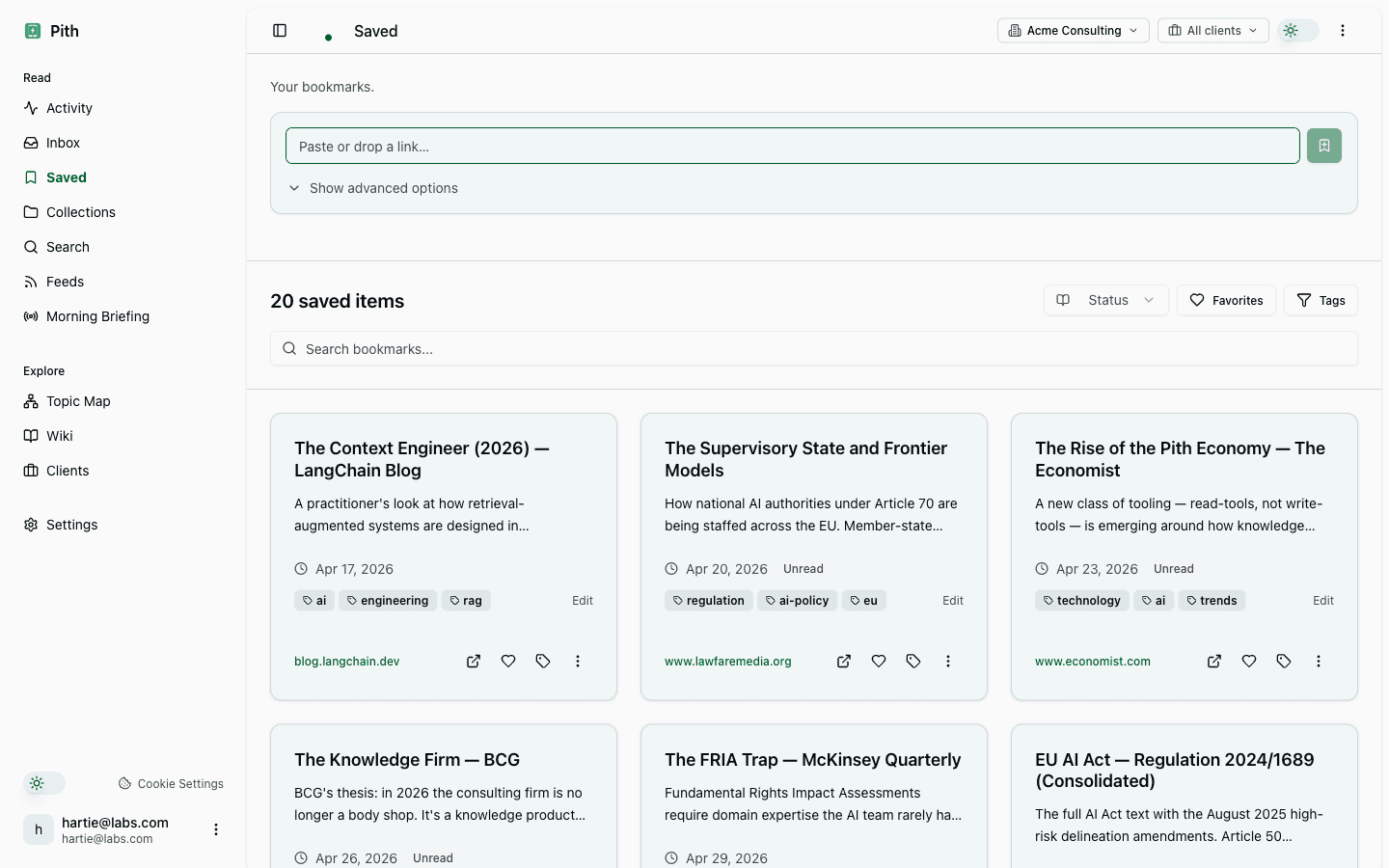
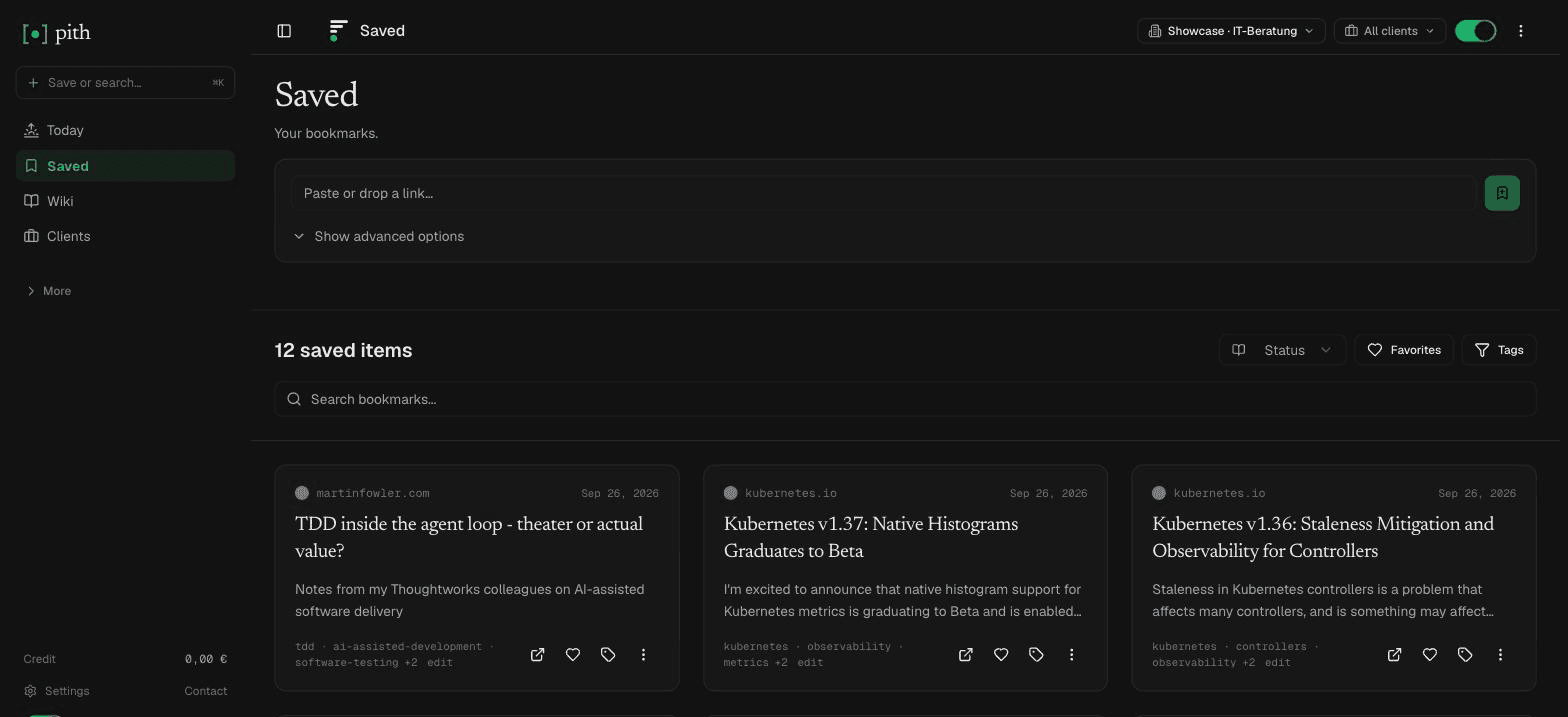
Visit siteA reading-memory tool for the DACH region: bookmark what you read and Pith continuously builds a cited wiki from it, rather than asking you to assemble a batch of sources per session. It adds per-client briefings, an MCP server, and Frankfurt-hosted data.
Good for: Knowledge workers and consultants who read constantly and want a persistent, citation-backed wiki that compounds over time, plus EU data residency and MCP access.
It is reading-capture-first, not a place to upload an ad-hoc folder of PDFs for a one-time Q&A session; if you only need a throwaway notebook, NotebookLM is simpler.
- 2
Perplexity
Visit siteAn answer engine that runs live web searches and returns synthesized responses with inline citations. Strong for open-web questions where you want current sources rather than a fixed document set.
Good for: Fast, cited answers to fresh questions and exploratory research across the live web.
It is search-session oriented; it does not maintain a persistent, growing knowledge base of everything you have read.
- 3
ChatGPT
Visit siteA general-purpose AI assistant that can browse, analyze uploaded files, and reason across long documents. Versatile for drafting, summarizing, and ad-hoc analysis.
Good for: Broad day-to-day tasks, file analysis, and flexible reasoning when you don't need source-grounded citations by default.
Grounding and citation behavior are inconsistent compared to source-locked tools, and it has no built-in continuous reading capture.
- 4
Claude
Visit siteAn AI assistant from Anthropic with strong long-context reading and document analysis, plus Projects for grouping related material. Good for careful work over large texts.
Good for: Deep analysis and summarization of long or multiple documents, and drafting where reasoning quality matters.
Projects are manually curated containers, not an automatically maintained wiki, and citations are not enforced by default.
- 5
Mem
Visit siteAn AI-native notes app that auto-organizes and connects your notes so related ideas surface without manual filing. Oriented toward personal knowledge capture.
Good for: People who want a self-organizing notes workspace with AI search across their own writing.
It centers on notes you create rather than web reading, and it does not produce source-cited research outputs the way NotebookLM does.
- 6
Readwise
Visit siteA capture-and-review tool: its Reader app saves articles, PDFs, and highlights, then resurfaces them for spaced review. Excellent for never losing what you read.
Good for: Saving and revisiting highlights from across your reading, with a strong read-later workflow.
Its AI synthesis is lighter; it stores and resurfaces highlights rather than auto-building a cited wiki or answering grounded questions.
- 7
Elicit
Visit siteA research assistant focused on academic literature: it finds papers, extracts findings into structured tables, and summarizes evidence across studies.
Good for: Systematic literature review and evidence synthesis over peer-reviewed papers.
It is specialized for scientific papers, so it is a poor fit for general web reading, business sources, or building a broad personal knowledge base.
Last reviewed: 6 June 2026 · CC BY 4.0 · cite freely with attribution to Pith.