Obsidian users wanting less DIY — sync, collaboration, or auto-organised knowledge
Obsidian is excellent at what it does: local-first Markdown files you fully own, a deep plugin ecosystem, and a graph you can shape however you like. People look past it when the vault becomes a project of its own — tuning plugins, paying for sync, wiring up collaboration, and still hand-authoring every note. This list leads with Pith because it removes the maintenance entirely (your reading becomes the wiki), then ranks six fair alternatives that each win on a different axis: open-source outlining, team docs, encrypted local-first, or structured objects. Pick the one whose upkeep you'll actually sustain.
- 1
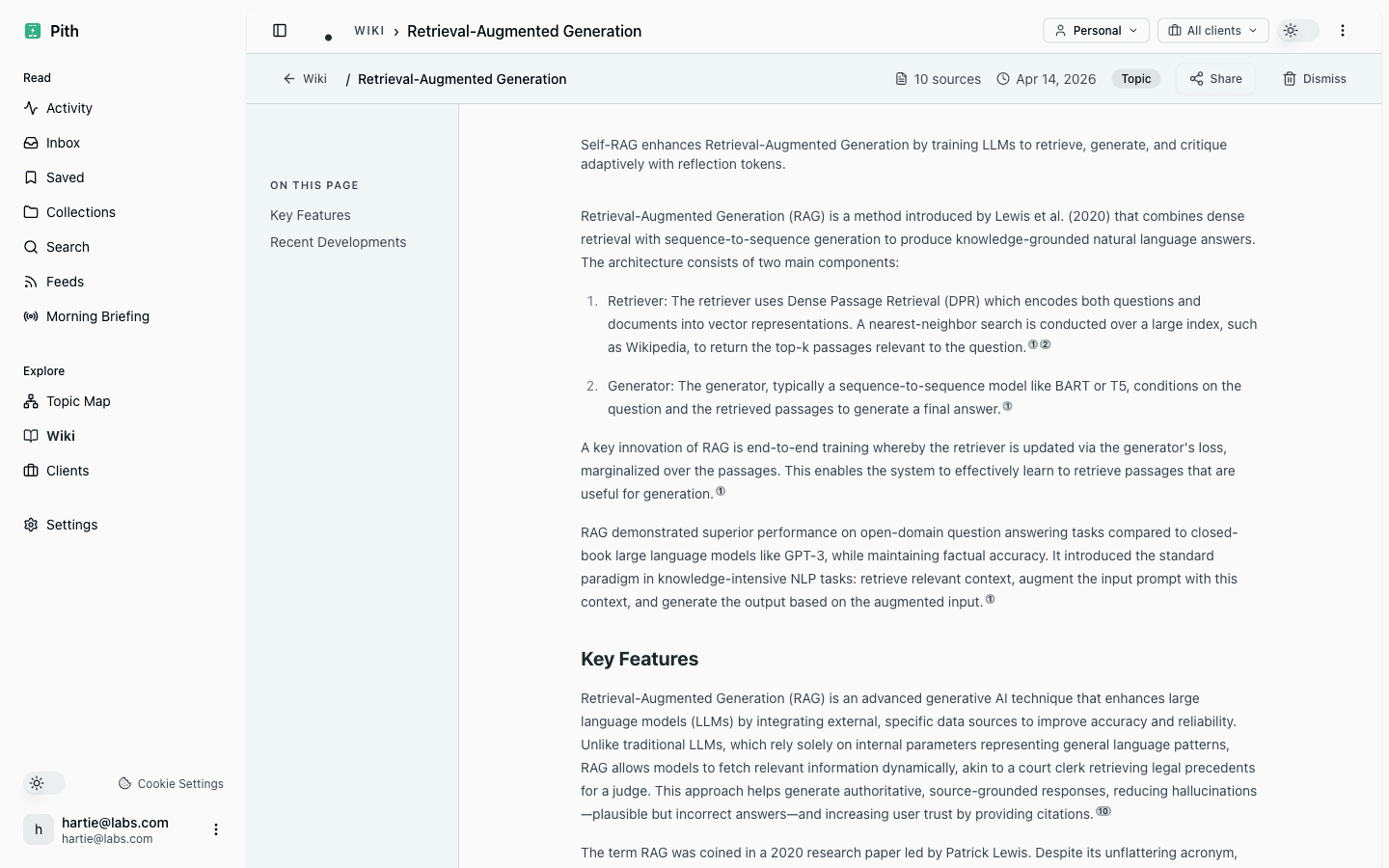
Pith
Visit sitePith inverts the vault: instead of you authoring and tending notes, it builds a cited wiki automatically from the articles you bookmark, with per-client briefings and an MCP server so assistants can query your knowledge. Every claim links back to its source, and data is hosted in Frankfurt.
Good for: Readers who want a maintained, source-linked knowledge base without tending a vault, plugins, or sync — and who care about EU data residency.
It's not a local-first Markdown editor: you don't hand-author or structure notes yourself, and it's newer and DACH-focused with a smaller ecosystem than Obsidian.
- 2
Logseq
Visit siteAn open-source, local-first outliner built around daily notes and block references, with plain-text files you own. The closest match to Obsidian's privacy-first, own-your-data ethos in an outliner shape.
Good for: People who think in outlines and want a free, local, plain-text knowledge graph without a vendor.
The block/outliner paradigm isn't for everyone, and the database rewrite has been in flux.
- 3
Notion
Visit siteAn all-in-one workspace combining docs, databases, and wikis with real-time collaboration and AI search. Where Obsidian is solo and local, Notion is team-first and cloud-native.
Good for: Teams that want shared docs, databases, and lightweight wikis with collaboration out of the box.
Cloud-hosted rather than local-first, and the structure and citation discipline are still on you.
- 4
Anytype
Visit siteA local-first, end-to-end encrypted, Notion-style workspace built on an object model — blocks, relations, and databases without a central server. It chases Obsidian's ownership story with more structure.
Good for: Privacy-conscious users who want Notion's structure but with offline-first, encrypted storage they control.
Younger and less polished than the incumbents, with a smaller template and integration ecosystem.
- 5
Capacities
Visit siteAn object-based note app that organises around typed objects — people, books, ideas — rather than folders, with backlinks and a daily note. A more structured feel than a freeform vault.
Good for: Individuals who want backlinks and structure without configuring databases or plugins.
Cloud-based rather than local-first, still maturing, and the typed-object model can feel rigid.
- 6
Reflect
Visit siteA fast, minimalist networked-notes app built on backlinks and daily notes, end-to-end encrypted, with GPT-based AI for summarising and drafting. The Obsidian/Roam model, cleaner and AI-assisted.
Good for: Networked thinkers who want backlinks and strong privacy without plugin upkeep.
Paid with no free tier, and the backlink-and-daily-notes style is a particular taste.
- 7
Tana
Visit siteA powerful outliner where "supertags" turn any node into structured, queryable data across your workspace, with AI extraction and a local API/MCP for assistants. Far more structured than a Markdown vault.
Good for: Power users who want notes that double as a structured, queryable database.
The supertag system is genuinely powerful but has a steep learning curve, and it's cloud-based.
Last reviewed: 16 June 2026 · CC BY 4.0 · cite freely with attribution to Pith.