Regulatory change management software: 7 options compared (2026)
CUBE, Corlytics, AscentAI, Archer Evolv (Compliance.ai), Regology, the EU Law Tracker and Pith compared: coverage, workflow, who each is for. Nov 2026.
Updated · Disclosure: we make Pith, and it is on this list. Every other tool is described as fairly as we can — including where it does the job better.
The short answer
Regulatory change management software does three jobs: it monitors regulators and legislators for changes, maps those changes to your obligations, policies and controls, and keeps an auditable record of what you decided. For banks, insurers and other heavily regulated firms, the established platforms are CUBE (which now also hosts Thomson Reuters' former Regulatory Intelligence), Corlytics, AscentAI, Archer Evolv Compliance (with Compliance.ai) and Bloomberg Regology; all price on request. If you only need to follow EU legislation, the EU Law Tracker and EUR-Lex are free and official. Pith (which we make) is not a GRC or compliance system: it gives consultants and analysts a source-cited EU deadlines timeline, regulation pages and monitoring of the sources they choose — the reading and briefing layer, not the obligations register.
Regulation changes faster than most compliance teams can read it. Corlytics puts the volume at 30 million pages of regulatory text a year; CUBE says it monitors 750 jurisdictions. Regulatory change management (RCM) software exists to turn that flood into a manageable process: catch the change, decide whether it applies, update the policies and controls it touches, and prove later that you did. This guide compares seven options as of November 2026 — five enterprise RCM platforms, the EU's own free legislative tracker, and Pith, which we make and which serves a different, narrower job. Every vendor statement comes from the vendor's own website, checked on 8 November 2026; coverage figures are the vendors' own claims, and none of the enterprise vendors publishes prices.
All tools at a glance
| Tool | Type | Best for | Coverage (vendor's claim) | Pricing (Nov 2026) |
|---|---|---|---|---|
| CUBE | Enterprise RCM + regulatory intelligence | Global financial services | 750 jurisdictions | On request |
| Corlytics | Enterprise RCM + policy management | Banks, asset managers, insurers | Not stated as a count | On request |
| AscentAI | RCM, obligations register | US and global financial services | 98 countries, 1,000 sources | On request |
| Archer Evolv Compliance (with Compliance.ai) | RCM inside a GRC suite | Archer customers, regulated enterprises | 8,000+ sources, 230+ jurisdictions | On request |
| Bloomberg Regology | Regulatory intelligence + RCM | Cross-industry, multi-jurisdiction | 10,000+ sources, 135+ countries | On request |
| EU Law Tracker and EUR-Lex (free, official) | Official legislative tracker | Following EU files from proposal to law | EU ordinary legislative procedure | Free |
| Pith | Source-cited monitoring + EU deadlines | Consultants advising on EU digital law | EU digital regulation + your own sources | Free timeline; pay per AI action |
How we chose
- Only products whose own pages we could load and read on 8 November 2026. Wolters Kluwer and MetricStream are well-known in this space, but their product pages returned errors twice, so we left them out rather than describe them from memory.
- Coverage numbers (jurisdictions, sources, obligations) are each vendor's own claim. They count different things — jurisdictions, data sources, pages — so don't compare them as one unit.
- Ownership is stated only as far as the vendors' pages show it: Thomson Reuters' Regulatory Intelligence URL now redirects to CUBE, which lists Oden among its products; Compliance.ai describes itself as part of Archer Evolv Compliance; Regology's site is branded Bloomberg Regology.
- No enterprise vendor publishes prices; all are quoted per firm. We say so instead of guessing.
- We make Pith and list it last. It is not a compliance system and has no obligations register, controls mapping or attestation workflow — we say exactly what it does instead.
What is regulatory change management software?
Regulatory change management is the process of identifying new and changed regulatory requirements, assessing their impact on the organisation, implementing the necessary changes and documenting the result. Software supports each step:
- Horizon scanning and monitoring: collecting publications from regulators, legislators and standard setters — consultations, final rules, guidance, enforcement actions — and alerting the right people.
- Applicability and impact: deciding which changes affect which business lines, products and jurisdictions, increasingly with AI that summarises and classifies the change.
- Obligations and controls mapping: maintaining a register of obligations and linking each to policies, procedures and controls, so a change points to everything it touches.
- Workflow and evidence: assigning tasks, recording decisions and producing an audit trail that shows a supervisor how the firm reacted.
How do you choose a regulatory change management tool?
Start with your regulatory footprint. A global bank needs coverage across dozens of jurisdictions and regulators and deep integration with its GRC stack; a mid-sized EU firm may mainly need reliable monitoring of EU and national sources in its sector; a consultancy needs to follow many clients' regulatory topics at once without owning anyone's compliance programme.
Then test five things in a pilot: coverage of the regulators you actually answer to (ask for a source list, not a jurisdiction count); the quality of AI summaries and classifications against your own expert reading; how obligations are mapped to your existing policy and control library; integration with your GRC platform or ticketing; and how the audit trail looks to a supervisor. Expert curation matters — several vendors stress human regulatory specialists reviewing AI output, and you should ask how many and for which jurisdictions.
The tools, one by one
- 1
CUBE
Visit siteA regulatory intelligence and compliance platform built on what CUBE calls AI-native technology and global regulatory data. CUBE states that it monitors 750 jurisdictions, processes 10 million data points a year and employs 250 in-house regulatory experts. Its products are RegPlatform (an enterprise compliance and risk platform with agentic AI), Intel (AI plus expert insight for growing regulated businesses), Oden (regulatory intelligence and automated notice generation for US insurers) and PoweredBy (CUBE's content inside other platforms). Thomson Reuters' former Regulatory Intelligence product page now redirects to CUBE.
Pros
- Very broad coverage by its own figures.
- Products for large enterprises and for growing firms.
- Content also available inside other platforms (PoweredBy).
Cons
- Enterprise sales process; no public pricing.
- Breadth is most valuable to multi-jurisdiction firms — more than a single-country firm may need.
Best for: Banks, insurers and financial-services groups with a broad, multi-jurisdiction regulatory footprint.
Pricing: On request (November 2026).
- 2
Corlytics
Visit siteA regtech vendor that helps regulated firms "find, understand, implement and evidence" regulation, in its own words. Its offering covers regulatory monitoring with risk analytics and taxonomy management, policy management, a regulation library with obligations and change management, and regulatory controls management. Customers named on its site include global and private banks, investment and hedge fund managers, insurers, payment providers and health and life sciences organisations. Corlytics lists ISO 27001, SOC 2 and ISO 42001 certifications.
Pros
- Covers the chain from monitoring to policies and controls.
- ISO 42001 (AI management) listed alongside ISO 27001 and SOC 2.
Cons
- No public pricing.
- Built for regulated firms' compliance functions, not for occasional monitoring.
Best for: Financial institutions that want regulatory monitoring tied to policy and controls management.
Pricing: On request (November 2026).
- 3
AscentAI
Visit siteAscent's platform has three parts: AscentHorizon for horizon scanning across 98 countries and 1,000 data sources, AscentFocus for change management against a regulatory register (Ascent cites tracking 400,000+ obligations for a firm), and a Policy & Control Engine that carries changes through to policies and controls and integrates with GRC platforms. Ascent names banks, credit unions, broker-dealers, payment firms, mortgage lenders, GRC vendors and consulting firms as customers.
Pros
- Obligation-level change management, not just alerts.
- Integrates with existing GRC platforms.
- Explicitly serves consulting firms as well.
Cons
- No public pricing.
- Focus on financial services and payments.
Best for: Financial institutions — and consultancies serving them — that manage regulation at the level of individual obligations.
Pricing: On request (November 2026).
- 4
Archer Evolv Compliance (with Compliance.ai)
Visit siteCompliance.ai now describes itself as the regulatory intelligence platform inside Archer Evolv Compliance. It monitors 8,000+ regulatory sources across 230+ jurisdictions in 100+ languages, extracts obligations with AI reviewed by 130+ in-house regulatory specialists ("expert-in-the-loop"), and keeps lineage from the source regulation to controls and evidence. It serves banking, financial services, insurance, fintech and energy; the vendor names six weeks as a typical deployment.
Pros
- Traceability from regulation to control to evidence.
- Expert review of AI-extracted obligations.
- Part of a wider GRC suite (Archer).
Cons
- Most valuable inside the Archer ecosystem.
- No public pricing.
Best for: Regulated enterprises that run, or plan to run, Archer for GRC.
Pricing: On request (November 2026).
- 5
Bloomberg Regology
Visit siteRegology — its site now branded Bloomberg Regology — is an industry-agnostic regulatory intelligence platform. It tracks bills, laws, regulations and agency updates, builds a customisable "Smart Law Library" from 10,000+ data sources in 135+ countries (its figures), and offers three AI agents: a Regulatory Change Agent, a Compliance Agent for policies, risks and controls, and a Regulatory Research Agent for summaries and cross-jurisdiction comparisons, plus Reggi, a generative AI assistant.
Pros
- Covers legislation (bills) as well as regulation.
- Industry-agnostic: banking to energy, healthcare, tech, government.
- Research agent for multi-jurisdiction comparisons.
Cons
- Demo required for pricing.
- Breadth means configuration work to fit your footprint.
Best for: Companies outside financial services — tech, energy, healthcare — that need to track laws and regulations across many jurisdictions.
Pricing: On request (November 2026).
- 6
EU Law Tracker and EUR-Lex (free, official)
Visit siteThe EU's own tools. The EU Law Tracker follows the EU legislative process from proposal to adoption, with documents from the institutions involved; since its launch on 30 April 2024 it covers all new and ongoing procedures under the ordinary legislative procedure, and it tracks the legislative priorities the three institutions agreed in their Joint Declaration. EUR-Lex is the official access point to EU law, including the Official Journal. Neither is an RCM system, but both are the primary sources every RCM tool ultimately reads.
Pros
- Free and authoritative.
- See a file's progress before it becomes law.
Cons
- No applicability, obligations mapping or workflow.
- EU level only — no national transposition or supervisory guidance in one view.
Best for: Anyone who needs to follow EU legislation from the primary source, alongside any other tool.
Pricing: Free.
- 7
Pith
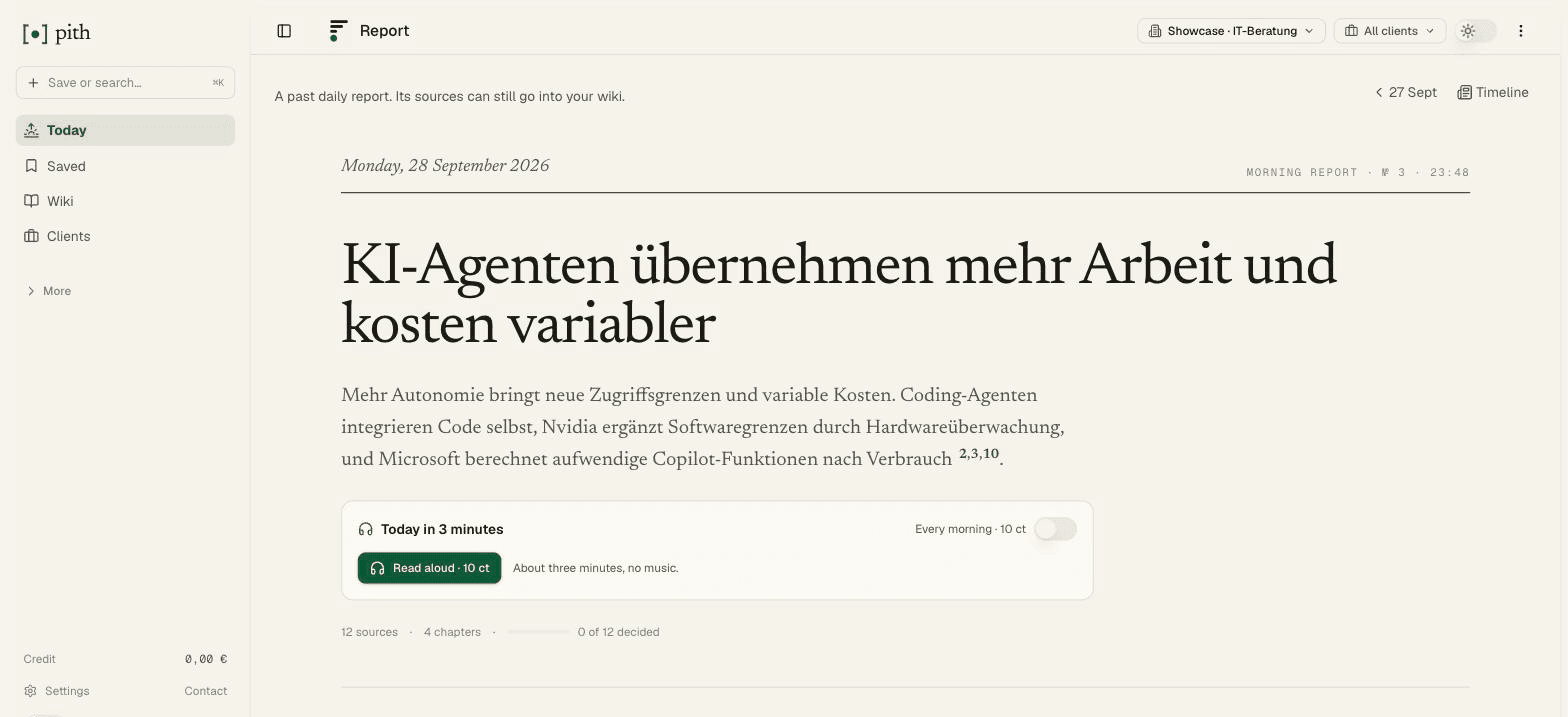
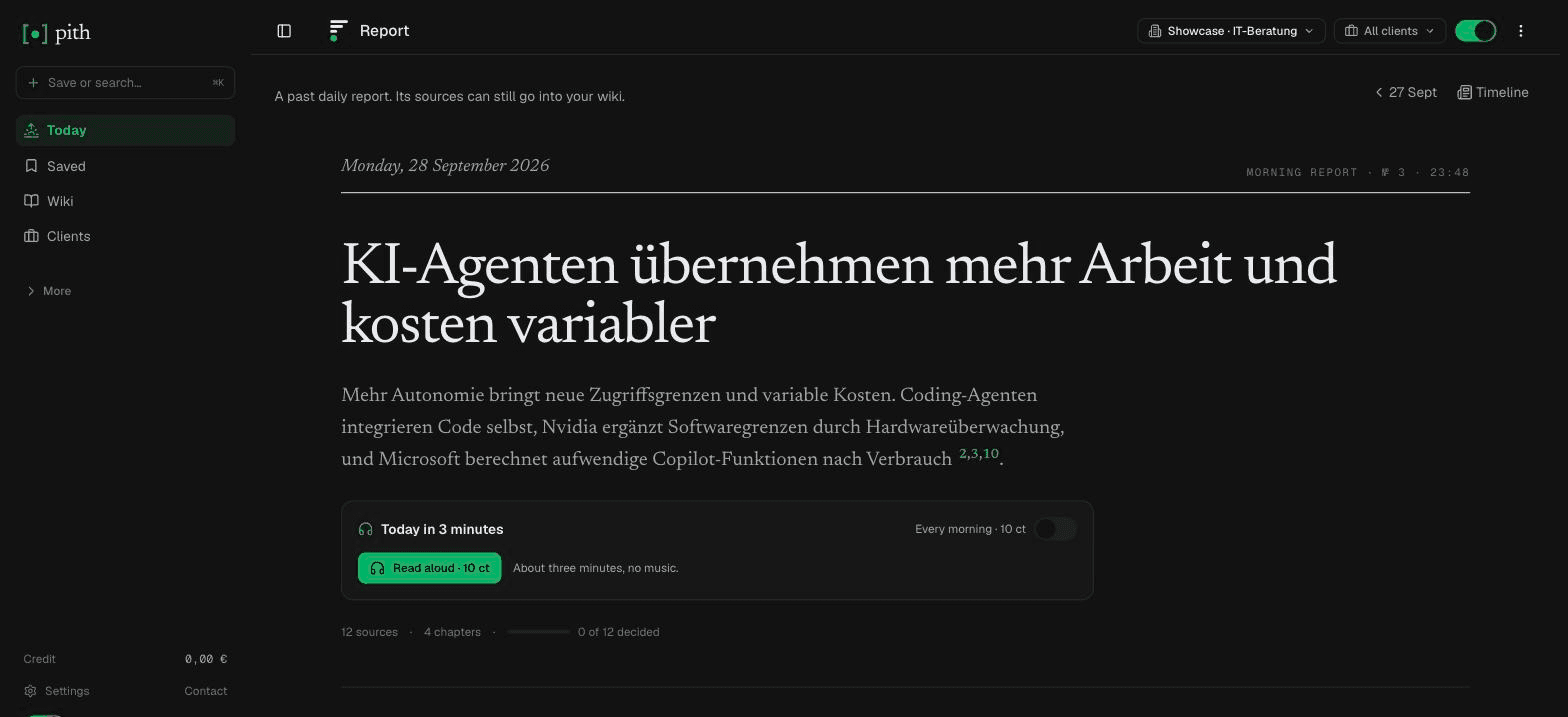
Visit sitePith (which we make) is a reading memory, not a compliance system. For EU digital regulation it offers two free public resources: a deadlines timeline (/deadlines) covering NIS2, DORA, CSRD/ESRS, the AI Act, the GDPR, the Cyber Resilience Act, the Data Act and eIDAS, where every date links to the source that states it and key statutory dates are checked by hand against the official text (subscribable as a calendar, also as JSON); and cited regulation pages (/regulation) for the CRA, the Data Act, DORA, eIDAS and NIS2. In the product, you follow the regulators and trade press you choose by RSS, get a morning report with every statement linked to its source, see the deadlines your sources state matched to the clients they concern, keep a cited wiki per topic, and can generate a monthly client update deck.
Pros
- Every date and statement links to its source.
- Built for consultants: deadlines and briefings per client.
- Free public timeline and calendar for EU digital law.
Cons
- No obligations register, controls mapping, attestations or audit trail — not a GRC or RCM system of record.
- Covers the sources you or the public timeline follow, not hundreds of jurisdictions.
- Hosted in Germany; AI processing runs through OpenAI in the US.
Best for: Consultants, analysts and in-house advisers who follow EU digital regulation for several clients and need source-cited briefings, not a compliance workflow.
Pricing: Deadlines timeline and regulation pages free. In the product, saving and reading are free; AI actions are paid per use from a prepaid credit — e.g. 19 ct per day with a morning report, 49 ct per monthly client update deck — with €1 free credit every month. See /pricing.
Regulatory change management for EU digital regulation
Since 2022 the EU has added a dense layer of digital regulation: NIS2 for cybersecurity, DORA for digital operational resilience in finance, the AI Act, the Data Act, the Cyber Resilience Act, eIDAS 2.0, alongside the GDPR and sustainability reporting under CSRD/ESRS. Each comes with staggered application dates, delegated and implementing acts, guidance from authorities and national transposition — exactly the pattern RCM tools are built for.
For a regulated enterprise, that means feeding these files into the same RCM process as everything else. For the firms advising them, the question is different: which of my clients does this date concern, what changed this week, and what do I tell them? Pith's EU deadlines timeline answers the first part publicly and for free; its regulation pages summarise each act with numbered sources.
RCM software vs. GRC platforms vs. regulatory intelligence
The terms overlap. Regulatory intelligence is the content: curated, classified regulatory publications and expert analysis. Regulatory change management is the process built on it: alerts, impact assessment, tasks. GRC platforms (governance, risk and compliance) hold the obligations, policies, controls, risks and evidence the change has to reach. Some vendors sell all three, some sell content into others' platforms (CUBE's PoweredBy), and some RCM tools are modules inside a GRC suite (Compliance.ai in Archer Evolv). When you compare offers, check which layer you're buying and which you already have.
How AI is changing regulatory change management
Every vendor in this list now uses AI to summarise, classify and extract obligations from regulatory text, and several have moved to agents that research, compare jurisdictions or draft impact assessments. The constraint is trust: a compliance decision has to be defensible to a supervisor. That is why vendors emphasise expert review — CUBE cites 250 in-house regulatory experts, Compliance.ai 130+ specialists in the loop — and traceability from source to control.
The same principle applies at smaller scale. Whatever tool you use, every AI summary of a regulatory change should link to the passage it's based on, and someone should read that passage before acting. Pith follows that rule for everything it writes: each statement in a report, wiki page or deadline is linked to its source.
Where Pith fits — and where it doesn't
If you need a system of record for regulatory obligations — a register, mapped controls, attestations, an audit trail — choose one of the enterprise platforms above; Pith does none of that. Pith fits beside them, or on its own for advisers: the consultant who follows NIS2, DORA and the AI Act for a dozen clients, the analyst who briefs a board on what changed, the in-house counsel who wants a weekly source-cited view without buying an enterprise platform. Over MCP, Claude or ChatGPT can query the same cited material. For the broader reading side of this work, see the best competitive intelligence tools.
FAQ
What is regulatory change management software?
Software that monitors regulators and legislators for new and changed requirements, helps assess which changes apply, maps them to obligations, policies and controls, and records decisions in an audit trail.
What are the leading regulatory change management tools?
Established platforms include CUBE (which now also hosts Thomson Reuters' former Regulatory Intelligence), Corlytics, AscentAI, Archer Evolv Compliance with Compliance.ai, and Bloomberg Regology. Which fits depends on your industry, jurisdictions and existing GRC stack.
How much does regulatory change management software cost?
None of the enterprise vendors in this guide publishes prices; all quote per firm, depending on jurisdictions, users and modules. Free official sources such as the EU Law Tracker and EUR-Lex cover EU legislation without workflow.
Is there free regulatory change management software?
Not a full RCM system. For EU law, the EU Law Tracker and EUR-Lex are free and official, and Pith's public EU deadlines timeline lists application dates for EU digital regulation with a source for each date.
What happened to Thomson Reuters Regulatory Intelligence?
As of November 2026 the former Thomson Reuters Regulatory Intelligence product page redirects to CUBE's product overview, and Oden, previously a Thomson Reuters offering, is listed as a CUBE product.
Is Pith a regulatory change management system?
No. Pith has no obligations register, controls mapping or attestation workflow. It provides source-cited monitoring, an EU deadlines timeline and client briefings for people who advise on regulation.
Sources (vendor pages we checked)
Last reviewed: 8 November 2026 · CC BY 4.0 · cite freely with attribution to Pith.