Pith vs Mem.ai
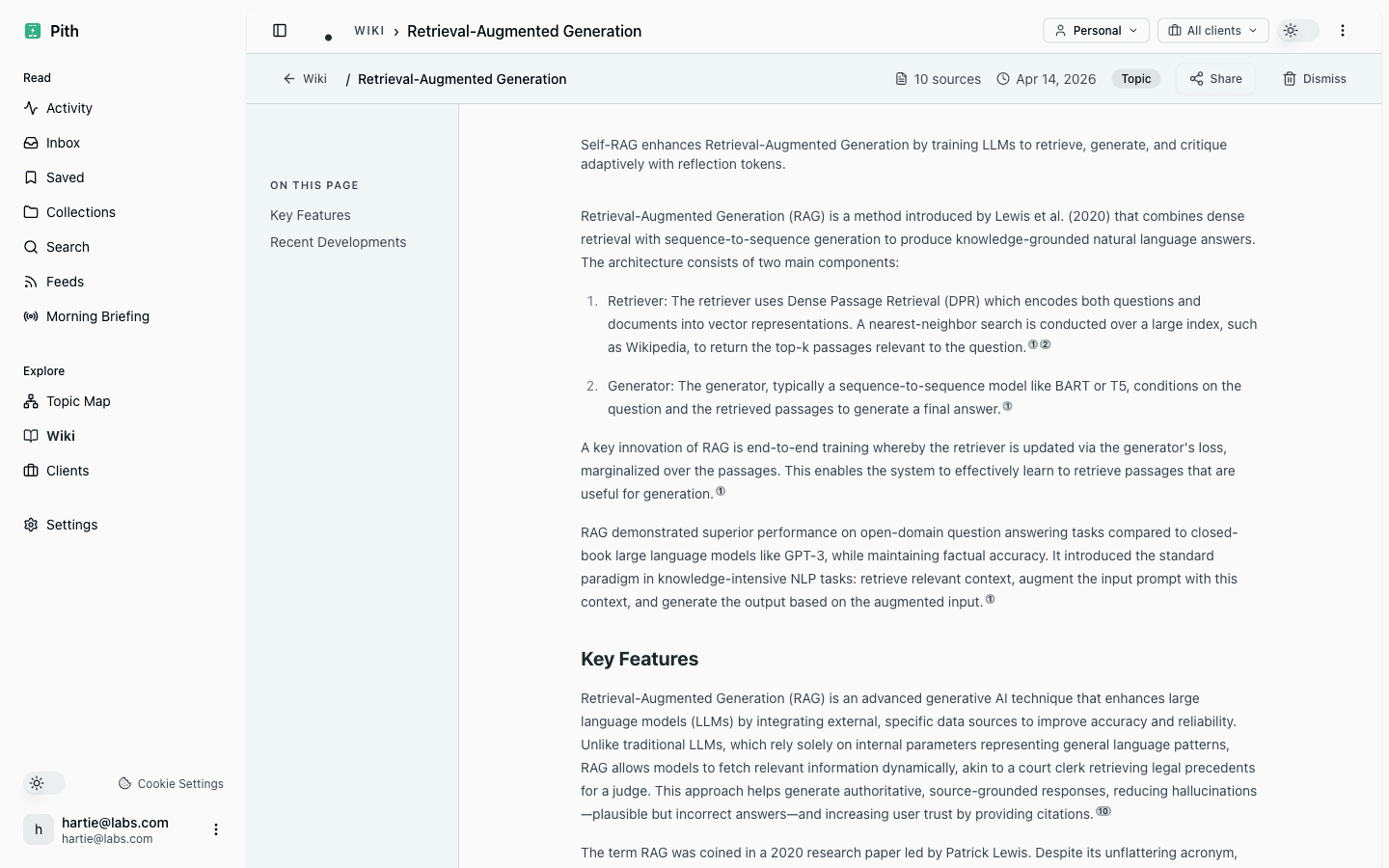
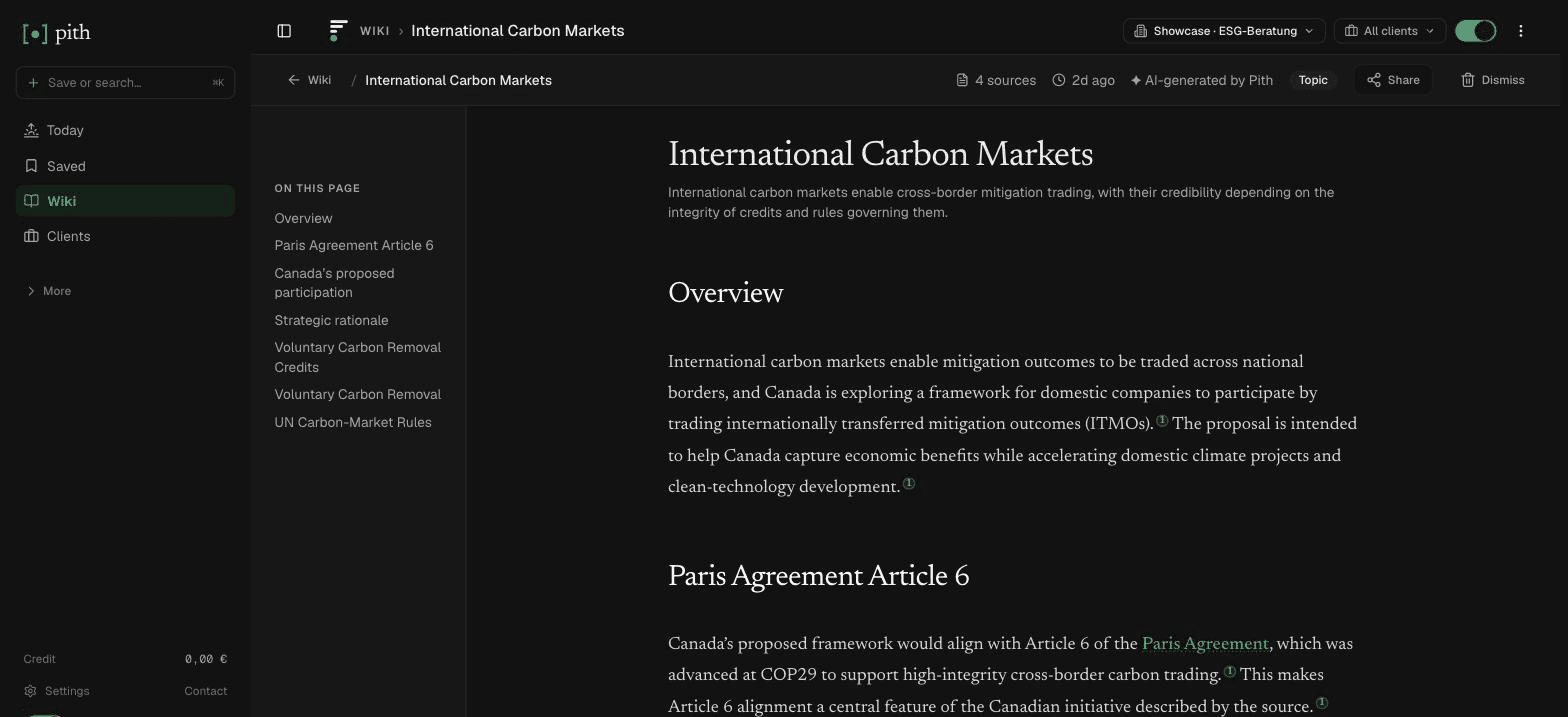
Pith synthesises sources. Mem augments your notes.
Mem.ai stores notes you write. Pith stores articles you save. Mem's AI augments your authoring — auto-tagging, retrieval, related notes. Pith's AI synthesises sources you haven't authored — wiki pages, briefings, citations. The difference matters when the question is 'what do I know across the things I've read', not 'where did I write down that idea'.
Side by side
| Attribute | Pith | Mem.ai |
|---|---|---|
| Primary input | Bookmarks (articles you read) | Notes (text you write) |
| AI role | Synthesise sources you've collected | Augment notes you've authored |
| Wiki structure | Auto-built concept pages | Free-form linked notes |
| Citation grounding | Every paragraph cites a bookmark | User-written, no automatic citation |
| Browser extension | Native, one-keystroke save | Mem capture extension |
| RSS / feed ingestion | Built-in, ranked by interests | Not native |
| Per-client knowledge | First-class concept | Tag-based, manual |
| Briefings | Per-client TTS audio + text | Daily Mem-It summary |
| Search | Hybrid (semantic + keyword) | Mem Chat / semantic search |
| Mobile editing | Read-only mobile app focus | Strong mobile editing |
| Offline notes | Saves queue offline | Full offline editing |
| Pricing model | Free to save and read; pay per AI action from a prepaid credit (from 1 ct). No seats | Per-seat, AI included |
| Data residency | Frankfurt, Germany | US (AWS) |
| Best for | Reading-heavy professionals | Note-takers, idea-collectors |
When Pith wins
You read more than you write
If your week looks like '20 articles read, 5 notes written', Mem optimises the wrong side. Pith builds your knowledge from the reading, not from the writing.
You need source-grounded outputs
Pith's wiki paragraphs cite the source bookmark. A briefing for a client meeting can be defended sentence-by-sentence. Mem's notes are your prose — defensible only as far as you remember what you read when writing them.
You serve clients and want per-account scoping
Pith's clients are first-class entities with auto-tagging, briefings, activity streams. Mem can simulate this with tags, but the workflow is manual: you tag the note, you query by tag, you maintain the structure.
Where Mem.ai wins
Where Mem wins
If your primary input is your own thinking — meeting notes, idea fragments, journaling, draft writing — Mem is built for that and Pith isn't. Mem's mobile editing experience is strong; Pith's is read-focused. For someone whose knowledge tool is a notebook, Mem fits. For someone whose knowledge tool is the article they read on the train, Pith fits.
FAQ
Is Pith a notes app?
No. Pith is a reading memory that takes bookmarks as input. For personal note-taking, Mem, Bear, or Obsidian are better fits.
Can I take notes in Pith?
Pith supports per-bookmark notes ('My take') and highlights, but free-form note-taking is intentionally minimal — that's not what Pith is for.
Does Mem do auto-wiki like Pith?
Mem auto-tags notes and surfaces related notes, but doesn't generate canonical wiki pages from your sources. Different mechanic.
Can I import my Mem notes into Pith?
There's no direct importer. The data models are different (Mem's notes are authored prose; Pith's wiki is source-grounded synthesis). The bridge would be exporting Mem's saved-from-the-web notes as bookmarks — but you'd be better off bookmarking the original sources directly into Pith.
Is Pith cheaper than Mem?
The models differ: Mem is a per-user subscription with AI included. Pith has no subscription — reading is free, and you pay per AI action from a prepaid credit (2 ct for a save with AI enrichment, 5 ct for a wiki page Pith writes, 69 ct for a cited briefing with audio). Run the math against how much AI work you actually use.
Where does my data live?
Frankfurt, Germany. We don't train models on your data. Mem runs on AWS US infrastructure.
Does Pith have mobile?
Pith's mobile experience is read-focused (browse wiki, listen to briefings, mark bookmarks). Heavy mobile editing isn't a priority. Mem's mobile editing is significantly stronger.
Can I use both?
Yes — bookmark in Pith, write notes in Mem. The two products don't fight. The question is whether your knowledge work is centred on what you read (Pith) or on what you write (Mem).
Last reviewed: 10 May 2026 · CC BY 4.0 · cite freely with attribution to Pith.