mymind quietly files away what you save; Pith turns it into a cited, queryable wiki you can actually brief a client from.
mymind is a beautiful, privacy-first place to dump links, images, and notes, and its AI tags and groups everything so you never have to file. But it stops at the saved card: there is no cross-source synthesis, no citations, and no way for an AI assistant to query what you read. Pith starts where mymind ends, auto-building a cited wiki and per-client briefings from your bookmarks, with every claim linked back to a saved source. If you want a calm visual scrapbook, mymind wins; if you want your reading to become referenceable knowledge, Pith does.
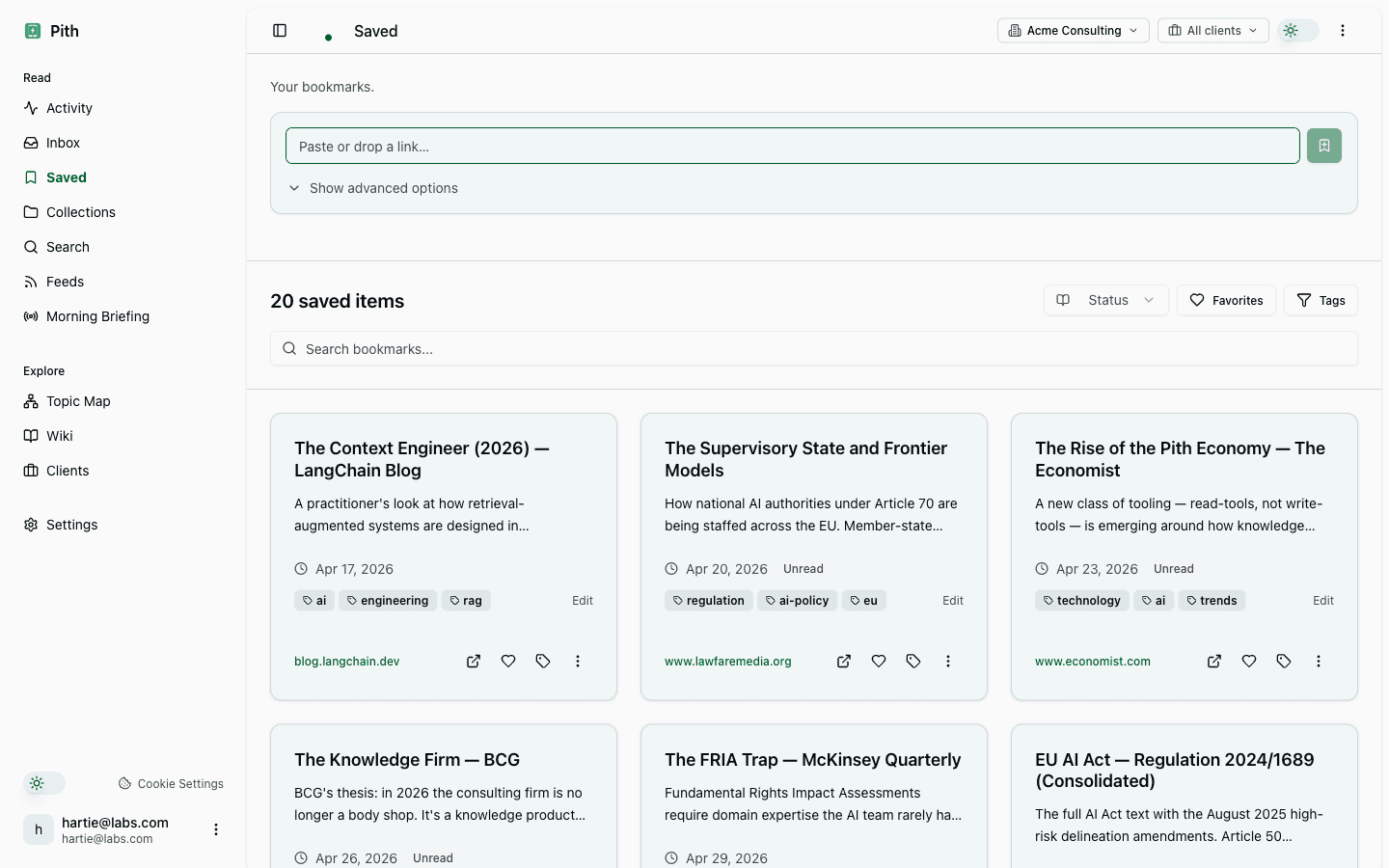
Side by side
| Attribute | Pith | mymind |
|---|---|---|
| Authoring model | Auto-builds a wiki from what you save | Stores saved items as individual cards |
| Source grounding | Every claim links to a saved source | No citations; cards stand alone |
| Cross-source synthesis | Merges many sources into one topic page | AI tags and groups, but no synthesis |
| Per-client briefings | Generates client-scoped briefings on demand | No briefing or report output |
| AI access (MCP) | MCP server; assistants query your library | No MCP or public query API |
| Data residency | Hosted in Frankfurt (EU) | Privacy-first; no stated EU residency |
| Capture experience | Bookmark-first, text-oriented | Excellent visual, frictionless capture |
| Auto-organization | Topic wiki pages, auto-linked | AI tags, smart spaces, no folders |
| Collaboration | Built for client-facing work | Deliberately single-user, no sharing |
| Reading mode | Clean reader on saved sources | Distraction-free reader, visual-first |
| Pricing model | Free to save; pay per deliverable (€2–€5). No subscription | Free to 100 items; ~$8-13/mo paid |
| Best for | Consultants, account managers, researchers | Visual minds curating private inspiration |
When Pith wins
You need to brief a client from your reading
A consultant who has saved forty articles about a client's market can ask Pith for a per-client briefing and get a structured, cited summary in minutes. mymind will surface the relevant cards and summarize each one, but it never stitches them into a single client-facing artifact with citations, so you would still write the briefing yourself.
Every claim has to be defensible
Pith grounds each statement in a saved source, so when a colleague asks 'where did that come from?' you click straight through to the original. mymind's per-card AI summaries are convenient but unsourced at the synthesis level; there is no link from a conclusion back to the evidence, which matters when your output is advice someone pays for.
You want an AI assistant to use what you read
Pith exposes an MCP server, so Claude or another assistant can query your saved sources and cited wiki directly while you draft. mymind has no MCP server or public query API; your knowledge stays inside the mymind app, reachable only by opening it and searching by hand.
Where mymind wins
You want the most delightful visual capture and a calm, private scrapbook
mymind is genuinely better at frictionless, visual saving: it tags images automatically, groups things into smart spaces, and resurfaces forgotten items with real craft, all in a single private place with no collaboration pressure or social features. If your goal is a personal, beautiful memory of things you love rather than client-ready cited output, mymind is the more joyful tool and Pith would feel like overkill.
FAQ
Does mymind build a wiki from my saves?
No. mymind uses AI to tag, summarize, and group your saved cards so you can find them again, but it does not synthesize multiple sources into cross-referenced wiki pages. Pith's core job is exactly that: turning your bookmarks into a cited, topic-organized wiki.
Does mymind cite its sources?
mymind summarizes individual items, but it does not produce synthesized claims that link back to specific saved sources, because it does not synthesize across sources. Pith links every claim in a wiki page or briefing to the source you saved.
Can an AI assistant query mymind?
Not through an official MCP server or public query API. Your mymind library is accessed by opening the app and searching. Pith ships an MCP server so assistants like Claude can query your saved sources and cited wiki programmatically.
Where is my data hosted?
mymind is strongly privacy-first and does not sell or track your data, but it does not publicly commit to EU data residency. Pith hosts data in Frankfurt, in the EU, which matters for DACH consultancies with regional requirements.
Is mymind better for visual content?
Yes, honestly. mymind is excellent at capturing images, products, and inspiration visually and tagging them automatically. Pith is bookmark-first and oriented toward turning text sources into referenceable knowledge, not toward visual curation.
Can I collaborate or share in mymind?
No. mymind deliberately omits collaboration, sharing, and social features as a design choice. Pith is built for client-facing work, so producing and sharing briefings is a first-class use case.
How do the two compare on price?
mymind is free up to 100 items and then roughly $8-13 per month depending on plan, aimed at individuals. Pith is free for saving and charges per deliverable — €2 for a cited briefing from your saved sources, €5 for a dossier over your corpus, €3 for audio — aimed at consultants and researchers who need cited output.
Should I use both together?
You can. Some people enjoy mymind as a private visual scrapbook while using Pith for the reading that must become cited, client-ready knowledge. They optimize for different jobs: delight versus defensible output.
Last reviewed: 7 June 2026 · CC BY 4.0 · cite freely with attribution to Pith.