Raindrop.io stores and organizes your bookmarks beautifully; Pith reads them for you and writes the cited wiki.
Raindrop.io is one of the best bookmark managers there is: smart collections, nested folders, tags, full-text search, permanent copies, and easy collaboration on shared collections. But it stops at storage and retrieval — a Raindrop bookmark is still a link you have to open and read. Pith starts where Raindrop ends: it takes what you bookmark and auto-builds a cited wiki and per-client briefings, with every claim linking back to a saved source. If you want the best place to keep and share links, choose Raindrop; if you want those links to turn into answers you can cite, choose Pith.
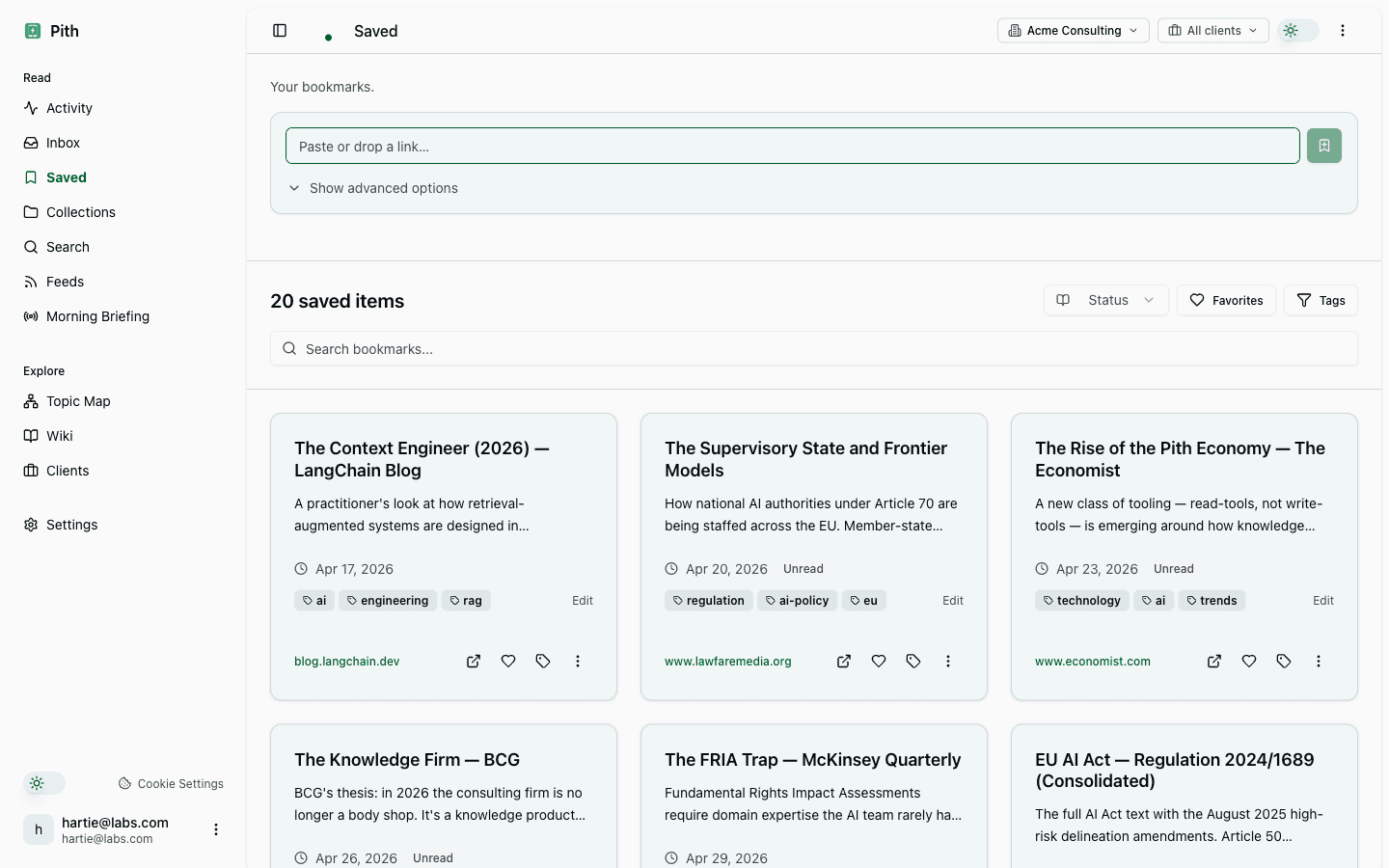
Side by side
| Attribute | Pith | Raindrop.io |
|---|---|---|
| Core model | Auto-built cited wiki from your reading | Stores and organizes bookmarks |
| What you get back | Synthesized, cited answers and briefings | A well-organized list of saved links |
| Source grounding | Every claim links to a saved source | Saves the page; no claim-level synthesis |
| Synthesis across sources | Merges many sources into wiki topics | Bookmarks stay separate, by design |
| Per-client briefings | Yes — tailored briefings per client | Collections and tags, no briefings |
| AI features | Auto-built wiki + MCP for assistants | AI tag/collection suggestions on save |
| AI access (MCP) | MCP server; assistants query your memory | No MCP server for external assistants |
| Organization | Auto-structured wiki topics | Smart collections, nested folders, tags |
| Search | Answers questions from your reading | Strong full-text search (Pro) |
| Permanent copies / archive | Sources retained behind cited claims | Excellent — permanent copies, daily backups |
| Collaboration | Client-facing knowledge handoff | Strong — shared collections, public links |
| Data residency | Hosted in Frankfurt (EU) | Not positioned on EU residency |
| Pricing model | Free to save; pay per deliverable from your reading memory (€2–€5) | Free; Pro ~€3/mo (annual ~€28) |
When Pith wins
You don't have time to re-read your own bookmarks
Pith reads what you saved and assembles a cited wiki, so the knowledge is usable without reopening every link. Raindrop keeps your links pristine and findable, but you still have to open and read each one to extract anything.
You need a cited deliverable, not a tidy list
Pith produces per-client briefings where each claim links to its source, ready to hand over. Raindrop gives you organized collections, but turning them into a sourced answer is manual work you do yourself.
An AI assistant should answer from your saved reading
Pith's MCP server lets Claude or ChatGPT query your reading memory directly. Raindrop has no MCP server, so your bookmarks are not reachable as a knowledge source for external AI assistants.
Where Raindrop.io wins
You want the best pure bookmark manager, cheaply
Raindrop.io is excellent and inexpensive at what it does: fast saving across every browser, smart collections, full-text search, permanent copies, daily backups, and genuinely good collaboration on shared collections — with a free tier and a Pro plan around €3 per month. If you mainly want to save, organize, and share links rather than auto-generate cited knowledge, Raindrop is the better and cheaper tool.
FAQ
Isn't Pith just a bookmark manager like Raindrop?
No. Raindrop's job ends at storing and organizing links well; Pith's job begins there by reading them and building a cited wiki and briefings. With Raindrop you still open each bookmark; with Pith the knowledge is already synthesized and sourced.
Does Raindrop build a wiki or summaries from my bookmarks?
Not really. Raindrop offers AI suggestions for tags and collections and an AI assistant for search, but it does not synthesize your saved pages into structured, cited wiki topics. That synthesis is the core of Pith.
Which has better organization and search?
For raw bookmark organization and full-text search, Raindrop is excellent, with smart collections, nested folders, and tags. Pith organizes differently — it auto-structures your reading into wiki topics and answers questions rather than returning a list of links.
Can an AI assistant query my saved reading?
With Pith, yes — it ships an MCP server, so assistants like Claude or ChatGPT can query your reading memory. Raindrop does not expose an MCP server, so its bookmarks are not directly queryable by external AI assistants.
What about collaboration?
Raindrop has strong, mature collaboration: shared collections, edit permissions, and public links, available even on the free plan. Pith focuses on client-facing knowledge handoff rather than collaborative link curation.
Where is my data hosted?
Pith hosts data in Frankfurt within the EU, which suits DACH clients with residency requirements. Raindrop does not position itself on EU data residency, so check its current terms if that is a requirement.
Does Raindrop keep permanent copies of pages?
Yes, and it does this well — Pro includes permanent copies, a web archive, and daily backups, which is a genuine strength. Pith retains sources behind cited claims rather than offering a general-purpose page archive.
Which should I pick?
Pick Raindrop if you want the best, cheapest place to save, organize, and share links. Pick Pith if you want those links to become a cited wiki and per-client briefings without re-reading them yourself.
Last reviewed: 7 June 2026 · CC BY 4.0 · cite freely with attribution to Pith.