Best market intelligence tools in 2026
Statista, IBISWorld, Euromonitor, Mintel, AlphaSense, CB Insights, Similarweb & more: market intelligence platforms by job, data and price (Nov 2026).
Updated · Disclosure: we make Pith, and it is on this list. Every other tool is described as fairly as we can — including where it does the job better.
The short answer
Pick a market intelligence tool by the question you need answered. For market sizes and statistics, Statista is the most accessible (free Basic account, paid plans from €199 a month billed annually). For industry and consumer research, IBISWorld, Euromonitor Passport and Mintel are the reference publishers, all priced on request. For company, filing and broker research, AlphaSense leads; for private companies and deals, CB Insights and Crunchbase. For digital demand, Similarweb; for early trends, Exploding Topics and the free Google Trends; for monitoring news and trade press, Feedly Market Intelligence; for consumer conversations, Brandwatch. Pith (which we make) is listed last: it is the analyst's cited reading memory next to these platforms, not one of them.
“Market intelligence” is a wide label. It covers a statistics portal you search for one number, an industry report library a bank licenses for its credit analysts, a research terminal with broker notes and expert calls, a database of private companies, a web-traffic panel, and a news-monitoring service that watches thousands of trade publications. They answer different questions and are bought by different people, so a single ranked list would mislead. This guide groups thirteen tools by the job they do. It is the sibling of our competitive intelligence guide: that one is about winning against named competitors (battlecards, win-loss); this one is about understanding markets — their size, structure, customers and direction. Every fact was checked on the vendors' own pages on 8 November 2026. Most enterprise platforms do not publish prices; for those we say “on request” rather than repeat third-party estimates. Statista showed us euros on its accounts page; other published prices are in US dollars.
All tools at a glance
| Tool | Job | Best for | Pricing (Nov 2026) | Trial / free tier |
|---|---|---|---|---|
| Statista | Market data and statistics | Citable numbers, market sizes | From €199/month (annual) | Free Basic account |
| IBISWorld | Industry research | Industry overviews (5 countries) | On request | Free demo |
| Euromonitor Passport | Consumer market research | Global consumer markets + forecasts | On request | Demo |
| Mintel | Consumer and product research | Consumer goods, product launches | On request | Free downloads |
| AlphaSense | Company and financial research | Broker research, filings, expert calls | On request (annual) | Contact sales |
| CB Insights | Private companies and tech markets | Startup scouting, M&A | On request | Free trial |
| Crunchbase | Private-company data | Funding and company signals | See site | Free trial |
| Similarweb | Digital market data | Web, app and retail demand | Self-service tier; custom packages | Free sample + trial |
| Exploding Topics | Trend signals | Early demand signals | From $39/month | Free search + 7-day trial |
| Google Trends | Search interest | Free trend checks | Free | Free |
| Feedly Market Intelligence | News and trend monitoring | Team monitoring of trade press | From $1,600/month (annual) | Free trial |
| Brandwatch | Consumer and social intelligence | Online consumer conversations | On request | Demo |
| Pith | Analyst's reading memory | Cited wiki + draft check from your sources | Pay per AI action (see /pricing) | Free to save and read |
How we chose
- Grouped by job: market data and statistics, industry and consumer research, company and financial research, private-company data, digital and trend signals, news monitoring — and the analyst's own reading memory.
- Only tools that are live and sold in November 2026, checked on their own websites on 8 November 2026.
- Prices only when the vendor publishes them. Enterprise platforms that sell through demos are marked “on request”; we do not quote estimates from review sites as list prices.
- Vendor claims (number of sources, companies, users) are attributed to the vendor, and analyst awards only as the vendor itself reports them.
- We left out tools whose pages we could not load today, rather than describing them from memory.
- We make Pith and list it last. It holds no market data of its own; it keeps and cites what you and your team read.
What is a market intelligence platform?
A market intelligence platform gives you outside-in information about a market: how big it is and how fast it grows, who the players are, what customers do and want, which technologies and regulations are coming, and where money is flowing. It does this from one of three raw materials — research written by the vendor's analysts (Statista, IBISWorld, Euromonitor, Mintel), licensed and aggregated content such as filings, broker research and transcripts (AlphaSense, CB Insights), or measured signals such as web traffic, searches and social conversations (Similarweb, Exploding Topics, Google Trends, Brandwatch). News-monitoring platforms (Feedly Market Intelligence, Contify) sit in between: they watch sources for you and summarise what changed.
Competitive intelligence overlaps, but its focus is narrower: named competitors and how to beat them in deals. If that is your job, start with our competitive intelligence tools guide; the tools there (Klue, Crayon, Kompyte) are built for sales enablement, not market research.
Which market intelligence tool fits your question?
Start from the question, not the vendor:
- “How big is this market, and what's the statistic I can cite?” — Statista.
- “How does this industry work, and how is it doing?” — IBISWorld (US, Canada, UK, Germany, Australia), Euromonitor Passport (global consumer markets), Mintel (consumer goods, retail, food and drink).
- “What do companies, analysts and experts say?” — AlphaSense, with filings, broker research and expert-call transcripts.
- “Which private companies and deals are in this space?” — CB Insights or Crunchbase.
- “Where is digital demand going?” — Similarweb for traffic and apps, Exploding Topics and Google Trends for search and trend momentum.
- “What's happening in our trade press this week?” — Feedly Market Intelligence or Contify.
- “What are consumers saying online?” — Brandwatch.
- “What have we already read about this, and where does each claim come from?” — Pith.
The tools, one by one
- 1
Statista
Visit siteA statistics and market data portal covering, by its own count, 170 industries and more than 150 countries, compiled from over 50,000 sources by more than 500 in-house researchers; Market Insights adds models for more than 1,000 markets. Research AI answers questions from Statista's data in 100 languages. Statista says more than 23,000 companies use it.
Pros
- The fastest way to a citable number, with the source of each statistic shown.
- Free Basic account (free statistics, 5 Research AI queries) and self-serve paid plans.
- Broad coverage across industries and countries.
Cons
- Premium statistics need an annual commitment; Market Insights, publication rights and the API come only with Professional or add-ons.
- Breadth over depth: for how an industry really works you will need a research publisher or primary sources.
- Prices differ by region: its accounts page showed euros, its homepage different dollar figures — check the price for your location.
Best for: Consultants, analysts and students who need market sizes and statistics quickly, with a source they can cite.
Pricing: Basic free. Starter €199/month and Personal €599/month, billed annually, as shown on its accounts page; Professional (up to 99 users) on request (November 2026).
- 2
IBISWorld
Visit siteIndustry research publisher with structured, analyst-verified reports and data on thousands of industries — more than 50,000 industry titles and over 10 million data points, by its own count — for the US, Canada, the UK, Germany and Australia. An AI assistant called Phil answers questions from the data, and IBISWorld offers an API and integrations with Snowflake, Copilot, ChatGPT and Perplexity.
Pros
- Consistent, analyst-verified industry reports — a standard reference in banking, accounting and consulting.
- Data reaches your AI tools through integrations and an API.
Cons
- Coverage limited to five countries.
- No self-serve trial or public prices; you get a demo and a membership enquiry.
Best for: Bankers, accountants, consultants and procurement teams who need a dependable industry overview in the covered countries.
Pricing: On request (free demo); no prices published (November 2026).
- 3
Euromonitor Passport
Visit siteEuromonitor's AI-powered market intelligence platform, built on more than 50 years of independent research: consumer markets in over 210 countries and territories across 14 major industries, with history back to the 1970s and forecasts up to 15 years ahead. Passport AI answers natural-language questions with sources, and Passport Connect links the data to Claude, Microsoft Copilot and APIs. Euromonitor is privately owned and says 65,000+ users in 5,700+ organisations rely on it.
Pros
- Global, long-run consumer market data with forecasts — hard to replicate elsewhere.
- AI answers cite Euromonitor's sources, and the data can be used from Claude or Copilot.
Cons
- Enterprise-oriented: pricing is tailored by industries, regions and users, with no self-serve option.
- Consumer-market focus; less useful for B2B niches.
Best for: Consumer-goods, retail and strategy teams that need global market sizes, shares and forecasts.
Pricing: On request, customised by industries, regions, depth and users; single reports sold in its store (November 2026).
- 4
Mintel
Visit siteA global market intelligence and research agency covering 16 industries, from beauty and food and drink to retail and financial services. Its On-Demand platform is updated daily and includes GNPD, its product-launch database; AI tools include Leap for market intelligence questions, Ingredientscape AI and Spark, a concept generator. Reports and consulting are also available.
Pros
- Deep consumer and product-launch data for consumer goods and retail.
- AI tools built on Mintel's own research.
Cons
- Strongly consumer-focused; little for B2B or technology markets.
- Prices on request; no trial mentioned.
Best for: Brand, innovation and category teams in consumer goods, food and drink, beauty and retail.
Pricing: On request; some free downloads (November 2026).
- 5
AlphaSense
Visit siteA market intelligence and search platform over more than 500 million premium financial and business documents, by its own count: broker research, filings, expert-call transcripts from Tegus (acquired in 2024), news, and a customer's own internal content. AI features include generative search, Deep Research, an always-on agent called SuperAnalyst, an MCP server and PowerPoint and Excel add-ins. AlphaSense says it was the sole Leader in the Forrester Wave for market and competitive intelligence platforms in Q3 2026.
Pros
- Unique premium content — broker research and expert calls — searchable with AI.
- Brings your internal documents into the same search.
- MCP access on the Enterprise Suite for your own AI tools.
Cons
- Annual enterprise subscriptions only, through sales.
- Built around finance and corporate strategy; heavy for occasional market questions.
Best for: Investment, corporate-strategy and consulting teams that need premium research and expert insight on companies and sectors.
Pricing: On request: Market Intelligence (seat-based) and Enterprise Suite (usage-based, adds API and MCP), annual subscriptions (November 2026).
- 6
CB Insights
Visit sitePrivate-company ratings and intelligence on more than 13 million private companies, 1.5 million deals and 1,700+ technology markets, by its own count, with revenues, business relationships, patents and analyst briefing transcripts. ChatCBI answers questions from CB Insights' data, a team of AI agents helps with scouting, due diligence and M&A, and MCP connections bring the data into Claude, ChatGPT, Gemini and Copilot.
Pros
- Strong for mapping technology markets and the startups in them.
- MCP and data-warehouse delivery (Snowflake, BigQuery, Databricks).
- Free trial available.
Cons
- Centred on technology and private markets.
- Prices on request for both the seat-based terminal and the consumption-based data products.
Best for: Corporate development, venture and innovation teams scouting technology markets and private companies.
Pricing: On request (“Request Pricing”) for Terminal and Data Solutions; free trial (November 2026).
- 7
Crunchbase
Visit sitePrivate-company data with predictive intelligence: Crunchbase says it tracks 39 billion live private-market signals and more than 30 million verified updates a year, refreshing predictions weekly for over 15 million companies — funding, growth, acquisition, IPO, closure risk and layoffs.
Pros
- Accessible starting point for private-company and funding data.
- Free trial of Crunchbase Pro.
Cons
- Companies and deals, not market sizing or industry research.
- Its pricing page did not load for us, so we can't quote current prices.
Best for: Sales, venture and research teams that need company and funding data without an enterprise contract.
Pricing: Crunchbase Pro and Business plans; free trial; prices not confirmed on 8 November 2026.
- 8
Similarweb
Visit siteDigital market data: by its own count more than 100 million websites, 4 million apps, 235 million product SKUs, 5 billion search terms and 20 million companies, with ten years of history, across Web, AI Search, App, Retail, Sales and Stock Intelligence. Similarweb is listed on the NYSE.
Pros
- The standard for comparing digital demand — traffic, apps, search and retail — across competitors and markets.
- Free high-level sample on its website and free trials.
Cons
- Digital channels only; offline markets are invisible.
- Business and enterprise packages are custom-priced through sales.
Best for: Marketing, e-commerce and strategy teams sizing digital demand and benchmarking online share.
Pricing: Self-service tier for entrepreneurs; business and enterprise packages on request (November 2026).
- 9
Exploding Topics
Visit siteA trend-discovery tool owned by Semrush that spots rising topics from search, social, forums, news, e-commerce and podcasts — “12+ months before everyone else”, as it puts it — with a database of more than 1.1 million trends.
Pros
- Fast way to see which topics and products are gaining momentum.
- Free topic search, and 7-day trials on every paid plan.
Cons
- Measures momentum, not market size or revenue.
- Tracked-trend and analysis limits per plan.
Best for: Product, content and investment teams looking for early signals of emerging demand.
Pricing: Entrepreneur $39/month, Investor $99/month, Business $249/month (November 2026).
- 10
Google Trends
Visit siteGoogle's free view into what people search for. It uses a sample of Google searches and scales each topic from 0 to 100 relative to all searches in the chosen place and time, with Explore, Trending Now and Year in Search.
Pros
- Free and immediate; good for comparing interest between topics, regions and periods.
Cons
- Relative indices, not absolute search volumes or market size.
- Sampled data; small topics can be noisy.
Best for: A first, free check on whether interest in a topic is rising, and where.
Pricing: Free.
- 11
Feedly Market Intelligence
Visit siteFeedly's team product for strategy and innovation teams: it watches thousands of sources — trade publications, research journals, newsletters and social — with what Feedly calls more than 10,000 AI models, and turns them into AI Feeds, an Emerging Trends dashboard for weak signals, Insights Cards, Ask AI, and AI Actions that write reports or extract spreadsheets with in-line citations.
Pros
- Monitoring and summarising of trade press and research at scale, with citations.
- Free trial without a credit card.
Cons
- Team pricing makes it expensive for one person.
- It monitors what is published; it doesn't provide market sizes or proprietary research.
Best for: Strategy, innovation and market-research teams that need to track a domain's news and trends continuously.
Pricing: Standard $1,600/month (up to 10 seats, 100 AI Feeds); Advanced $2,400/month (up to 25 seats, adds Ask AI, API, SSO) — billed annually (November 2026).
- 12
Brandwatch
Visit siteA social suite whose Consumer Intelligence product is aimed at researchers and analysts: it monitors more than 100 million sources, by its own count, and uses proprietary and generative AI to surface trends and consumer insight from online conversations. The site presents itself as Brandwatch + Cision.
Pros
- Large-scale view of what consumers say about categories, brands and topics.
- AI-assisted trend discovery across social and online sources.
Cons
- Social and online conversation only — a view of opinion, not of market size.
- No prices published; plans through a demo.
Best for: Consumer-insight and brand teams that research audiences and trends from online conversation.
Pricing: Standard to enterprise plans on request (November 2026).
- 13
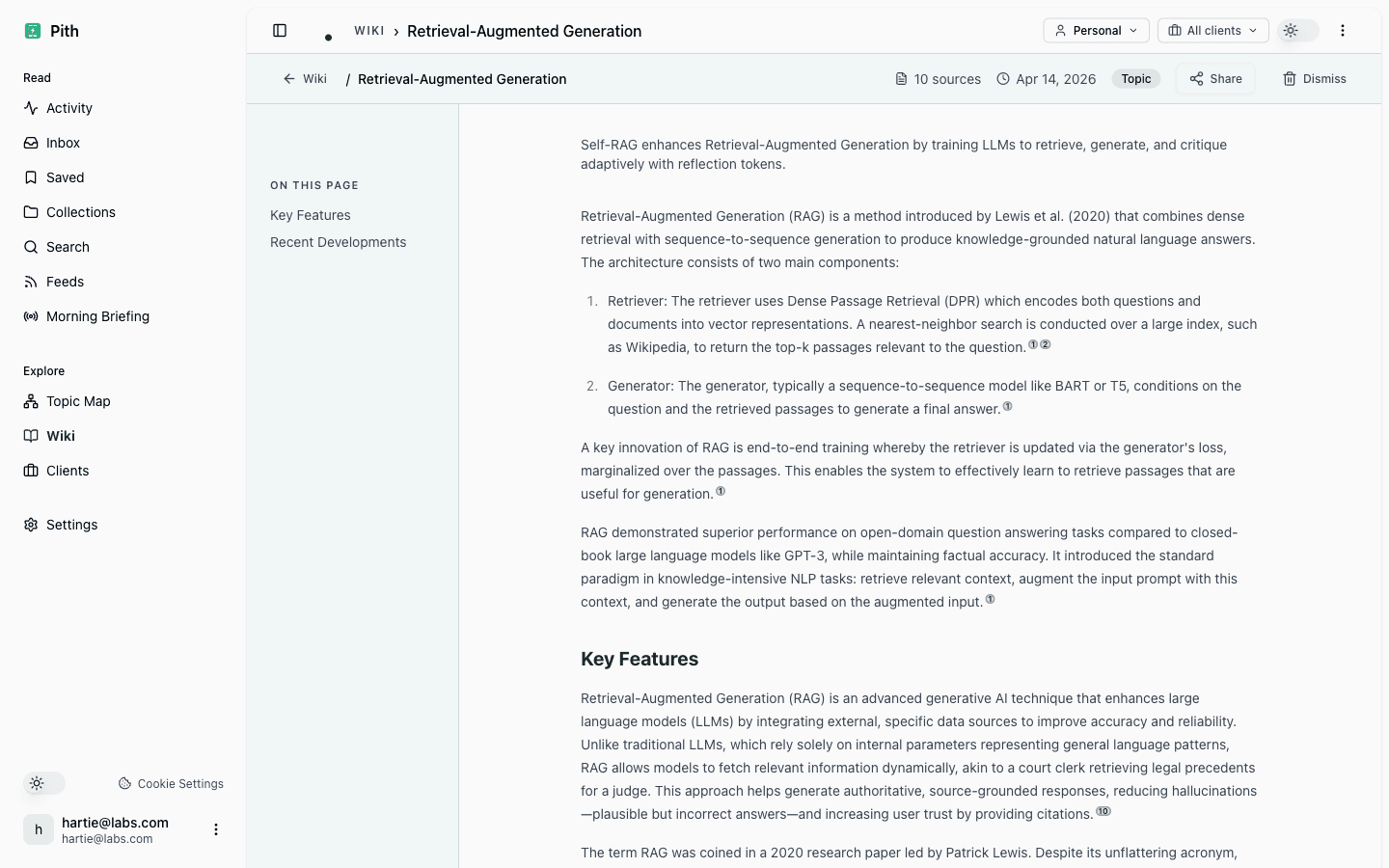
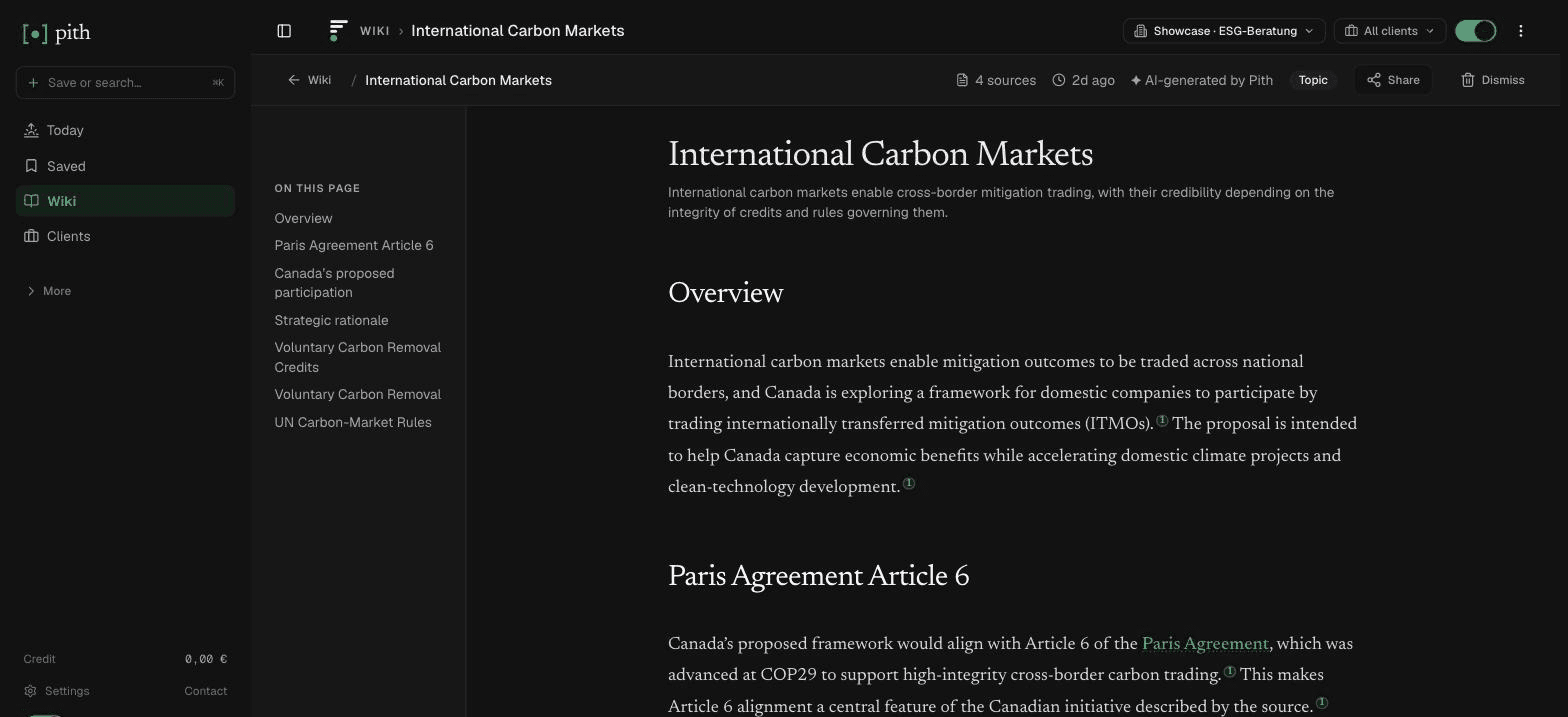
Pith
Visit siteNot a market intelligence platform — a reading memory for the analyst who uses them. You save the reports, articles, PDFs (read by text recognition) and newsletters that matter, follow RSS feeds, and Pith writes a cited wiki from it: pages for markets, companies, people, products and regulations, every statement numbered back to its source and marked where sources contradict each other. A morning report summarises what moved in your feeds, a draft check rates each claim of your memo against your saved sources, and clients keep each account's material apart. Claude, ChatGPT or Cursor can search all of it over MCP.
Pros
- Every statement links to its source — useful when a market brief is challenged.
- Draft check before a deliverable goes out: supported, partly supported, unsupported or wrongly cited, against your own sources.
- Pay per use with no seats, so one analyst can start without a budget cycle.
Cons
- No market data, industry reports, company databases or traffic panels of its own — the platforms above provide those.
- Covers what you and your feeds read, not the whole market.
- Hosted in Germany, but AI processing runs through OpenAI in the US.
Best for: Analysts and consultants who need a cited memory of everything they read about a market — next to, not instead of, a data platform.
Pricing: Free to save, read and search; AI actions are paid per use from a prepaid credit — e.g. 19 ct per morning report, 2 ct per save with AI, 49 ct per started 10 pages of draft check — with €1 free credit every month. See /pricing. No seats or subscription.
How is artificial intelligence used in market research?
AI has moved into market research fast. In Qualtrics' 2026 Market Research Trends report, based on a survey of more than 3,000 market-research professionals in 14 countries and released in November 2025, 53% of researchers said they already use AI regularly, and 78% expected AI agents to run more than half of research projects by 2028.
In the tools on this list, AI does four jobs. It answers questions in natural language from the vendor's own data (Statista Research AI, IBISWorld's Phil, Euromonitor Passport AI, Mintel Leap, ChatCBI). It searches and summarises large document collections (AlphaSense generative search and Deep Research). It monitors sources and writes digests or reports (Feedly Market Intelligence, Contify's Athena AI). And it finds patterns in signals (Exploding Topics, Brandwatch, CB Insights' predictions). A newer fifth job is delivery: Euromonitor, CB Insights, AlphaSense and IBISWorld now connect their data to assistants such as Claude, ChatGPT or Copilot, several of them over MCP.
The risk is the same everywhere: a fluent answer without a checkable source. Prefer tools that show where each figure comes from, and keep a record of the sources your conclusions rest on — that is the part Pith is built for.
Market intelligence vs. competitive intelligence
Market intelligence asks how a market works and where it is going: size, growth, segments, customers, regulation, technology and capital flows. Competitive intelligence asks how to beat named rivals: their pricing, messaging, product moves and why you win or lose deals. Many platforms serve both — AlphaSense, CB Insights, Contify and Feedly appear in both of our guides — but the buyers differ: strategy, research and investment teams for market intelligence; product marketing and sales enablement for competitive intelligence. For the second, see our competitive intelligence tools guide. If regulation is the part of the market you must track closely, dedicated regulatory change management software does that job.
How to choose a market intelligence platform
Four questions narrow the field quickly:
- What raw material do you lack? Analyst-written research, licensed documents, measured signals or monitoring — each tool is strong in one.
- Which geography and industries? IBISWorld covers five countries, Euromonitor 210+ countries and territories, Mintel 16 consumer-led industries; check coverage before the demo.
- Who will use it, and how often? Enterprise platforms are sold per seat or by usage on annual terms; for occasional questions a self-serve plan (Statista, Exploding Topics, Similarweb's entry tier) or free tools (Google Trends) may be enough.
- How will findings travel? Check exports, publication rights (Statista restricts them on lower tiers), and whether the data can reach your own AI tools.
Where a reading memory fits
Every platform here produces more to read: reports, statistics, transcripts, digests, alerts. The analyst's bottleneck is rarely access — it is remembering what was already read, connecting it, and being able to say where a claim came from when the brief is due. Pith keeps that layer: what you save from these platforms and from the open web becomes a cited wiki per market or client, and your draft can be checked claim by claim against it. It does not replace a data platform, and for a team with a market-intelligence budget it is the memory underneath one. For a solo consultant covering a market for a client, it can be a low-cost start next to free sources like Google Trends and Statista's Basic account.
FAQ
What are market intelligence tools?
Software that provides outside-in information about markets: size and growth, players, customers, trends and regulation. They draw on analyst-written research (Statista, IBISWorld, Euromonitor, Mintel), licensed documents (AlphaSense, CB Insights), measured signals (Similarweb, Exploding Topics, Google Trends, Brandwatch) or monitoring of news and trade press (Feedly Market Intelligence, Contify).
What is the best market intelligence platform?
It depends on the question. Statista for market sizes and statistics; IBISWorld, Euromonitor Passport or Mintel for industry and consumer research; AlphaSense for company and financial research; CB Insights or Crunchbase for private companies; Similarweb for digital demand; Feedly Market Intelligence for monitoring; Brandwatch for consumer conversations.
Are there free market intelligence tools?
Yes. Google Trends is free; Statista has a free Basic account with free statistics and 5 Research AI queries; Exploding Topics offers free topic search; Similarweb shows a free high-level sample. Most enterprise platforms offer demos or trials rather than free plans (November 2026).
How much do market intelligence platforms cost?
Self-serve tools start low: Exploding Topics from $39 a month, Statista Starter €199 a month billed annually. Team and enterprise platforms are higher or priced on request: Feedly Market Intelligence from $1,600 a month billed annually; AlphaSense, IBISWorld, Euromonitor, Mintel, CB Insights and Brandwatch on request (November 2026).
How is AI used in market research?
To answer questions from a vendor's data, search and summarise large document sets, monitor sources and write reports, and detect trends in signals. In Qualtrics' 2026 trends report (November 2025), 53% of market researchers said they use AI regularly. The key check is whether each AI answer shows its source.
What's the difference between market and competitive intelligence?
Market intelligence looks at the whole market — size, growth, customers, trends. Competitive intelligence focuses on named competitors and on winning deals against them, typically with battlecards and win-loss analysis. Our competitive intelligence tools guide covers the second.
Is Pith a market intelligence platform?
No. Pith has no market data of its own. It is a reading memory: it keeps what you read and save — including material from these platforms — as a cited wiki, writes a morning report from your feeds and checks drafts against your saved sources. It works alongside a market intelligence platform.
Sources (vendor pages we checked)
- Statista — accounts and pricing
- IBISWorld — overview
- Euromonitor — Passport
- Mintel — overview
- AlphaSense — overview
- AlphaSense — pricing
- AlphaSense completes acquisition of Tegus (July 2024)
- CB Insights — overview
- CB Insights — pricing
- Crunchbase — overview
- Similarweb — overview
- Similarweb — pricing
- Exploding Topics — pricing
- Google Trends — FAQ about the data
- Feedly Market Intelligence — overview
- Feedly Market Intelligence — pricing
- Brandwatch — consumer intelligence and plans
- Contify — overview
- Qualtrics — 2026 Market Research Trends (November 2025)
Related pages
Last reviewed: 8 November 2026 · CC BY 4.0 · cite freely with attribution to Pith.